First Bulgarian Empire: rulers and capitals

First Bulgarian Empire: rulers and capitals


First Bulgarian Empire: rulers and capitals
Approximate reading time: 7 minutes


The origins of the Bulgarian state go back to 632, when Khan Kubrat united most of the Bulgar lands that had formed part of the extensive Avar-Bulgar khaganate. This union covered lands north of the Black Sea, bounded by the Carpathians, the Caucasus and the Volga, and was known in historical sources as Volga Bulgaria or Great Bulgaria. The precise year in which it was recognised as a state is disputed. Some place this as early as 635, under Khan Kubrat. The generally accepted view, however, regards Khan Asparuh, Kubrat's successor, as its actual founder. After Great Bulgaria broke up, Asparuh settled in the territories of present-day Bessarabia and Dobrudja. Together with local Slavic tribes, he won the Battle of Ongal in 680. This resulted in a peace treaty with Byzantium recognising the newly established state. Its first capital was Pliska, in present-day north-eastern Bulgaria. In the years after its foundation, successive rulers sought lasting political relations with Byzantium, territorial expansion and stronger state institutions.
Khan Asparuh ruled until around 700, when Khan Tervel succeeded him. One of Tervel's greatest achievements was victory over the Arab Caliphate's army during the siege of Constantinople in 717, halting its invasion of European territory. Bulgaria expanded to the south-east. Tervel also received the title of caesar, formally recognising the Bulgarian ruler's right to govern the territories occupied by the Bulgarians. After Tervel, the last members of the Dulo clan took the throne: Khan Kormesiy (Kormisosh), 721–738, and Sevar, 738–753. From 753, rulers of the Vokil clan headed the state, beginning with Vineh, who took power that year. Years of political instability followed, with frequent changes of ruler. Byzantium launched several campaigns into Bulgarian territory, but these had no major territorial or political consequences. Bulgarian authority recovered only under Khans Telerig (768–777) and Kardam (777–802). Their stabilisation of the state laid the foundations for its flourishing under Khan Krum (803–814). Early in his reign, Krum launched several large campaigns to the north-east and annexed extensive territories: Transylvania, Banat and eastern Pannonia. Their natural resources strengthened Bulgaria's economy. This prompted Emperor Nikephoros I to campaign against the growing Bulgarian power. Campaigns in 807 and 808 failed for the Byzantines. In 809, Krum captured Serdica. Despite negotiations, he could not secure a truce and began preparing an attack. Krum managed to avoid the capture of the capital Pliska, although the Byzantines burned it. After inflicting this defeat on Bulgaria, Nikephoros I set off back towards Byzantium. When his army entered the Varbitsa Pass on 26 July 811, however, Bulgarian forces attacked suddenly and routed it completely. These events encouraged Krum to continue his military operations and advance south. He captured Thrace and important fortresses such as Develt. Fighting continued near Versinikia in 813. After another victory, Krum led his troops towards Constantinople. A Byzantine attempt to kill him provoked further large-scale devastation in Thrace. Preparations for another siege of Constantinople then began, but on 13 April 814 news arrived of Krum's death. Some accounts say he died of a heart attack; others that he was poisoned.
Krum's reign was marked by more than territorial and military strength. He also worked hard to consolidate the state. Its expansion and the diverse population of the annexed territories required the introduction of common laws for all inhabitants.
Krum was succeeded by Khan Omurtag, who ruled from 814 to 831. In domestic affairs, he continued and developed Krum's policy of centralising power. A thirty-year peace treaty with Byzantium allowed him to undertake major reforms and extensive construction. Material evidence survives in the so-called Süleymanköy treaty, discovered near Sechishte in the Novi Pazar area, which preserves some of its clauses. Omurtag is remembered for his ambitious building programme. Pliska was restored after Nikephoros I burned it in 811, and a new khan's palace with a throne hall was built. Work began on stone reliefs, most notably the Madara Rider, and on numerous stone inscriptions written in the Greek alphabet. Many royal residences, water conduits and bridges were constructed. Omurtag died in 831 and was succeeded by his third son, Khan Malamir (831–836), followed by Malamir's nephew Presian (836–852). The years 839–842 saw a war with Serbia in which military fortunes fluctuated. Malamir and Presian continued Bulgaria's expansion towards Aegean Thrace and throughout Macedonia.
In 852, Presian's son Boris took the Bulgarian throne. Among the most significant events of his reign was the adoption of Christianity in the Bulgarian lands. The khan assumed the title of prince, seeking to break with pagan traditions. At baptism, Boris also took the name Michael in honour of Emperor Michael III. Bulgaria began to integrate into European and Christian civilisation. Churches were built, with services conducted in Greek by Byzantine priests. Boris recognised the danger that Byzantine clergy might assimilate the Bulgarian population culturally. To preserve Bulgarian identity, he welcomed the disciples of Cyril and Methodius at his court. With the ruler's support, their efforts created the Bulgarian alphabet and spread literacy and the written word among the population. In 879–880, the Ninth Ecumenical Council established an independent, autocephalous Bulgarian archbishopric, freeing it from dependence on the Church of Constantinople.
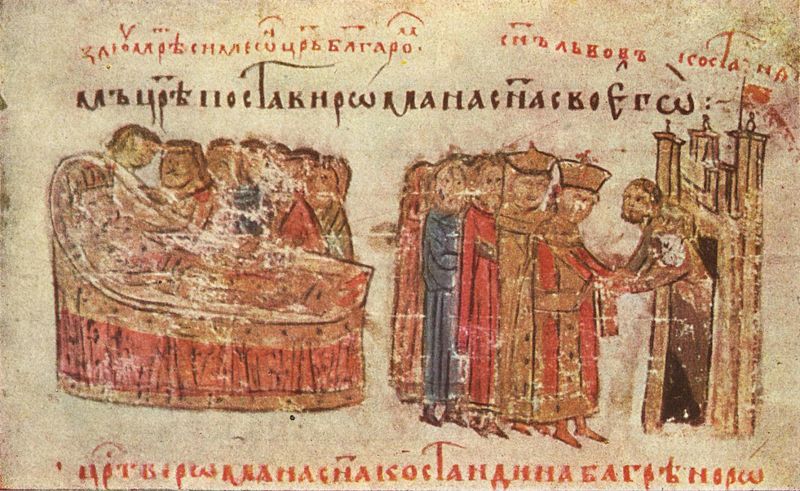
The next ruler was Simeon I. He continued his father Boris's religious and educational work while again pursuing territorial expansion and political power. One of the best-known battles in Bulgarian history took place during his reign: the Battle of Achelous on 20 August 917. The Byzantine army led by Leo Phokas suffered a crushing defeat with tens of thousands of casualties. Even afterwards, Byzantium refused to recognise Simeon's imperial title. He therefore contacted the papacy in Rome and received a favourable response. In 926, legates of Pope John X arrived in Preslav, authorised to crown Simeon as tsar and proclaim the Bulgarian Church a patriarchate. The ruler did not live to see these plans realised: he died of a heart attack on 27 May 927.
Alongside its political and military strength, Simeon I's reign is known as the Golden Age of medieval Bulgaria. The country reached a cultural high point and became a spiritual and literary centre. Intensive literary work took place at the Preslav and Ohrid schools, founded under Boris. Simeon transformed the new capital, Preslav, into a distinctive religious and cultural centre. Twenty cross-in-square churches, numerous monasteries, an imposing royal palace and the Golden, or Round, Church were built there. Art also flourished, notably Preslav painted ceramics.
After Simeon's death, his son Peter I (927–970) took the throne. He concluded peace with Byzantium, which formally recognised his imperial title and the patriarchal rank of the Bulgarian Church. His reign was the most peaceful period in medieval Bulgarian history. One of his main tasks was to combat the heresies spreading among the population, the strongest of which was Bogomilism.
After Peter I's death in 969, a gradual political crisis began, with several changes of ruler. Byzantium conquered all of Thrace and Moesia, and the capital Preslav fell. Samuel took the throne in 997, and the capital moved to Ohrid in Macedonia. His reign was marked by military defeats culminating in Byzantine victory over Bulgaria. His heaviest defeat came on 29 July 1014 at the Battle of Kleidion near the village of Klyuch. Between 14,000 and 15,000 Bulgarian soldiers were captured. Emperor Basil II ordered that one man in every hundred should retain one good eye. When the blinded army reached Prespa, Samuel could not endure the sight and died. His successor, Gavril Radomir, fell victim to a coup, and his cousin Ivan Vladislav occupied the throne in 1015–1018. Presian II was the last ruler of the First Bulgarian Empire. Basil II continued his military policy in Bulgarian territory, and in 1018 the last Bulgarian fortress fell under Byzantine rule. This ended the First Bulgarian Empire, which remained under Byzantine domination until 1185.
Share:


Rulers during this period