Kutmichevitsa

Kutmichevitsa
Kutmichevitsa is a historical region of exceptional importance to the development of Bulgarian culture, education and church organisation in the ninth and tenth centuries. Situated in the south-western part of the First Bulgarian Empire, it encompassed territories in modern south-western Macedonia and parts of Albania and north-western Greece. Under Prince Boris I (852–889) and later Tsar Simeon the Great (893–927), Kutmichevitsa became one of the Bulgarian state's spiritual and cultural pillars.
After the Bulgarian people's conversion to Christianity in 864 under Prince Boris I Michael, Kutmichevitsa became a strategic centre for spreading Christianity and Slavic literacy. Incorporated into Bulgaria in the mid-ninth century, the region served as a stronghold against Byzantine and papal influence, particularly in the borderlands with Epirus and Thessaly.
Prince Boris appointed Dometian governor of Kutmichevitsa. He was one of the region's first spiritual leaders, and intensive Christianisation of the local population began during his tenure.
After 886, when the disciples of Cyril and Methodius were expelled from Great Moravia, Prince Boris received and sheltered St Clement of Ohrid, Naum of Preslav and their companions. The prince sent Clement to Kutmichevitsa, where he carried out exceptionally productive work as an educator, cleric and teacher.
At the ecclesiastical and national Council of Preslav in 893, Clement was ordained bishop of the Diocese of Velika, centred on Velichko, now Berat in Albania. This made Kutmichevitsa the Bulgarian Church's first Slavic diocese. He thus became the first bishop to preach in Old Bulgarian.
Over approximately thirty years, Clement taught grammar, theology and literature to more than 3,500 pupils, laying the foundations of the Ohrid Literary School, one of medieval Bulgaria's most significant cultural centres. Important liturgical books were translated into Old Bulgarian and circulated in Kutmichevitsa.
After Tsar Simeon I (893–927) ascended the throne, Kutmichevitsa remained a key region in Bulgaria's cultural policy. Simeon, himself a pupil of scholars in Preslav and Constantinople, created conditions for further growth in literature and spiritual life throughout the state, including Kutmichevitsa.
Simeon encouraged translations and the creation of original literature, with Kutmichevitsa playing a key role alongside Preslav. By supporting Clement and Naum, Simeon not only expanded Bulgaria's territory but also strengthened the Bulgarian people's spiritual independence and cultural identity.
Kutmichevitsa was important to Bulgarian literature. It produced the first trained priests, scribes and teachers who spread Slavic literacy and Christian teaching throughout the Bulgarian state and neighbouring lands.
After Clement of Ohrid's death in 916, his work was continued by other clerics, including Naum of Ohrid, also a disciple of Cyril and Methodius. He founded a monastery near Ohrid, on the site of today's Monastery of St Naum.
Kutmichevitsa played a decisive role in strengthening Christianity, developing Old Bulgarian literature and preserving the Bulgarian people's national identity in the ninth and tenth centuries. Thanks to Prince Boris I's visionary policies and the cultural flourishing under Simeon the Great, the region became one of the brightest centres of the Bulgarian Middle Ages, whose significance resonates far beyond modern Bulgaria's borders.
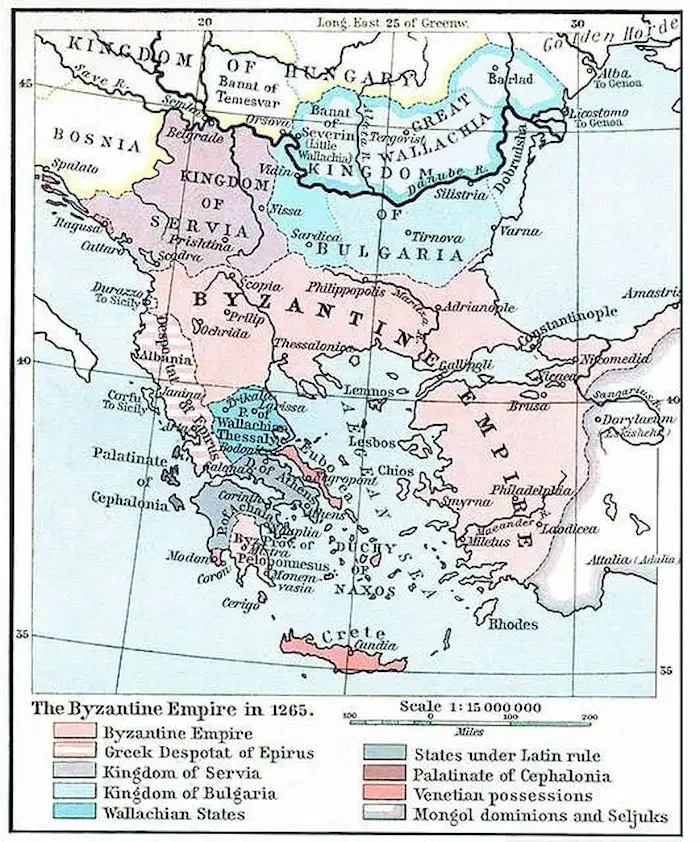
This historical map from 1265, created by William R. Shepherd, shows the geographical and political boundaries of the medieval Balkan Peninsula, including Kutmichevitsa as an important part of the Bulgarian state. The map was taken from Wikimedia Commons and is in the public domain, allowing its free use.
Share:


