Moesia

Moesia
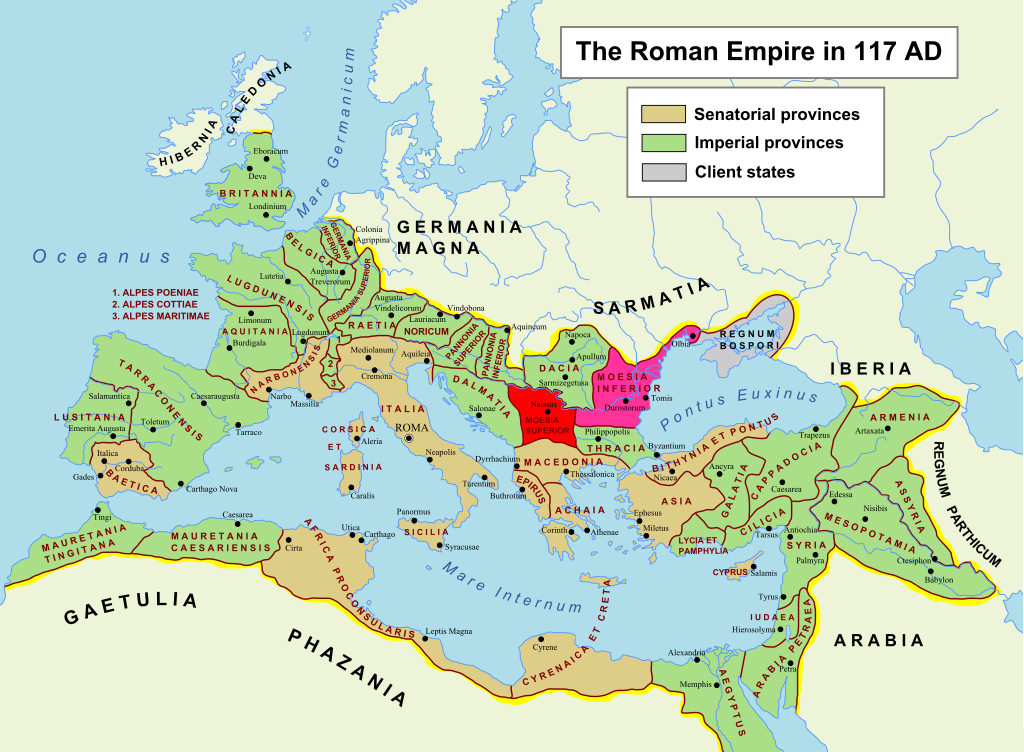
Moesia is the name Roman authors used for the ancient historical region and province on the southern bank of the Danube. Its name derives from the Thracian tribe of the Moesi. The region includes territories now lying within Romania, Bulgaria and Serbia.
In remote antiquity, before the Roman conquest, the lands of Moesia were inhabited by Thracian tribes, principally the Moesi and Triballi. Strategically situated between the Danube and the Balkan Mountains, the region played a key role even in prehistoric and early historical times. Archaeological finds attest to agriculture, metallurgy and trade as early as the Neolithic and Bronze Age.
In AD 15, during the reign of Emperor Tiberius, Moesia was incorporated into the Roman Empire and became an official province. Under Emperor Trajan (98–117), the region was divided into Moesia Superior (Upper Moesia) and Moesia Inferior (Lower Moesia). Cities such as Ratiaria (modern Archar), Sexaginta Prista (modern Ruse) and Nicopolis ad Istrum flourished as important Roman centres with infrastructure, amphitheatres, forums and baths.
In 395, following the division of the Roman Empire, Moesia came under the control of the Eastern Roman (Byzantine) Empire. In the sixth century, under Emperor Justinian I, defensive walls and basilicas were built to protect against incursions by Slavs, Goths and Avars.
In the sixth and seventh centuries, Slavs began settling in large numbers along the Danube. They lived alongside the local population and gradually intermingled with it. In the second half of the seventh century, with Khan Asparuh's foundation of the First Bulgarian Empire in 681, Moesia found itself at the centre of the new state. After the Battle of Ongal and the victory over Byzantium, the territories south of the Danube became an official part of Bulgaria.
During the First Bulgarian Empire, Moesia played an important role in the development of the state's political and cultural structures. The capitals Pliska and, later, Preslav were situated here. Under Khan Krum, Khan Omurtag and Tsar Simeon the Great, the region flourished as a political and spiritual centre. The Preslav Literary School was a major driving force of the Golden Age of Bulgarian culture in the late ninth and early tenth centuries.
After the uprising of the brothers Asen and Peter in 1185, Moesia once again became the core of the restored Bulgarian state, the Second Bulgarian Empire. Its new capital, Tarnovgrad (modern Veliko Tarnovo), in eastern Moesia, established itself as a spiritual and political centre of the Balkans. Numerous monasteries, fortresses and urban settlements were built in the region during the thirteenth and fourteenth centuries, demonstrating its cultural and economic growth.
After Bulgaria fell under Ottoman rule in the late fourteenth century, Moesia became part of the Ottoman Empire's new administrative structure. Despite the loss of statehood, the Bulgarian spirit in the region remained alive. Numerous rebellions broke out here, including the uprising of Konstantin and Fruzhin in the fifteenth century. Throughout the period of Ottoman rule, Moesia retained an important role in sustaining national memory and church tradition.
With Bulgaria's Liberation in 1878, Moesia became part of the newly established Principality of Bulgaria and, later, the Kingdom of Bulgaria. Towns such as Pleven, Ruse, Svishtov, Lom and Vidin developed as industrial and commercial centres. Bulgaria's first theatre, first printing house and first town plan in a European style were created in Ruse. The Serbo-Bulgarian War of 1885 confirmed the region's importance: the Battle of Slivnitsa, on Moesia's border, was decisive in preserving the Unification.
During the Kingdom of Bulgaria and subsequently within the People's Republic of Bulgaria, Moesia continued to be an important region. Rapid industrialisation began after 1944, with factories built in Pleven, Vratsa, Vidin and Montana and the development of heavy and light industry, as well as agriculture. By the 1980s, the region was among the country's most urbanised and economically active.
Today, Moesia encompasses large and small towns with a rich historical heritage, including Ruse, Pleven, Vidin, Vratsa, Svishtov and Lom, which remain important cultural, commercial and educational centres. Its territory continues to bear the imprint of thousands of years of history, reflected in its fortresses, museums, literature and the spirit of its people.
Share:


