Budjak

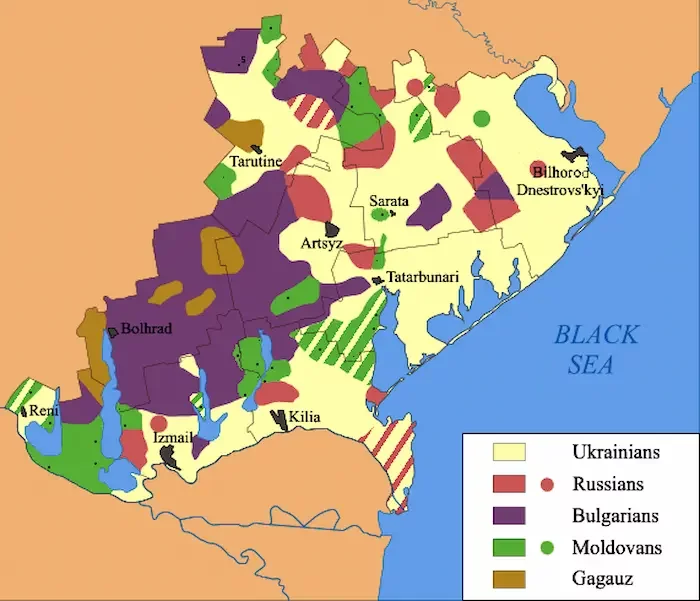
Budjak
Budjak is a historical and geographical region between the Dniester and Danube rivers and the northern Black Sea coast. Today, it lies within Ukraine's Odesa region and partly in Moldova, but over the centuries it has played an important role in Bulgarian history, particularly during the First and Second Bulgarian Empires, Ottoman rule and the Bulgarian National Revival.
The earliest known Bulgarian traces in Budjak date to Khan Asparuh in the seventh century. After establishing Danubian Bulgaria in 681, he expanded his influence northwards and north-eastwards. By the ninth and tenth centuries, under Prince Boris I and Tsar Simeon the Great, the Bulgarian state controlled the lands around the Danube Delta and the steppes of modern Bessarabia, including Budjak.
During the First Bulgarian Empire, these territories served as a buffer against the Pechenegs and other nomadic tribes. Archaeological finds around settlements such as Izmail and Bolhrad confirm a Slavic-Bulgarian population in the region from the early Middle Ages.
After Bulgaria fell under Byzantine rule in 1018, the Byzantines temporarily took control of the northern Black Sea lands. Local resistance to Byzantine domination continued, and Tsar Peter II Delyan (1040–1041) organised an uprising that also resonated among the population of Budjak and Bessarabia.
In the thirteenth and fourteenth centuries, after Tsar Ivan Asen II (1218–1241) restored the Second Bulgarian Empire, Bulgarian influence increased once again. Ivan Asen II expanded Bulgaria's territories as far as the Black Sea, including present-day south-western Budjak.
After Bulgaria fell under Ottoman rule in 1396, many Bulgarians sought refuge outside the Ottoman Empire. Budjak and Bessarabia became major destinations for Bulgarian refugees, particularly during the Chiprovtsi Uprising of 1688, the Ruschuk Uprising of 1806 and the Russo-Turkish wars of the eighteenth and nineteenth centuries.
In 1806–1812, following one of the Russo-Turkish wars, the Russian Empire occupied the region and began settling Bulgarians in Budjak. This led to the establishment of Bulgarian settlements such as Bolhrad, Artsyz, Tarutino, Kamenka and Chushmeliya, now Vasylivka.
In 1858, the first Bulgarian secondary school outside the Ottoman Empire, Bolhrad High School, opened in Bolhrad with the support of the Russian general Inzov and the local Bulgarian community.
The school became a centre of Bulgarian education and the National Revival. Many future National Revival figures and revolutionaries studied there, including Dimitar Agura, Grigor Nachovich, Petko Slaveykov and Sava Dobroplodni.
Following Bulgaria's Liberation in 1878, many Bulgarians in Budjak maintained active ties with the newly established state. Some returned, while others stayed and preserved Bulgarian traditions, language and faith. Today, tens of thousands of Bessarabian Bulgarians still live in Ukraine's Odesa region, preserving the memory of their ancestry.
During the 1990s and after Ukraine's independence, the Bulgarian minority continued to be officially recognised, and Bulgarian schools, cultural centres and publishers existed in Bolhrad, Tarutino and other villages.
Share:


