Dobruja

Dobruja
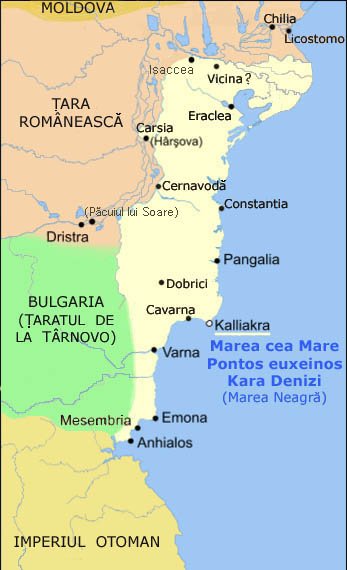
Dobruja is a historical and geographical region in eastern Bulgaria, situated south of the Danube and west of the Black Sea. It covers around 23,000 square kilometres. Rich in history and cultural diversity, it is also an important geopolitical area. Its territory is divided into Northern Dobruja, in Romania, and Southern Dobruja, in Bulgaria. Southern Dobruja contains the provinces of Dobrich and Silistra.
Dobruja is one of Europe's oldest inhabited territories. Archaeological excavations reveal traces of Neolithic and Chalcolithic settlements dating back to the sixth and fifth millennia BC. Thracians inhabited the region for centuries; better-known tribes include the Getae, Tiltae and Crotali. Trading centres such as Zaldapa, near modern Abitovo, developed at the mouth of the Danube, along with important settlements on the route between the river's mouth and the Black Sea.
In 29 BC, under Emperor Octavian Augustus, Dobruja came under Roman rule. The province of Moesia was established, incorporating Dobruja. Fortresses, roads and military camps were built here over the following centuries. Cities such as Durostorum (modern Silistra) and Tomis (modern Constanța, Romania) became important administrative and military centres. Following the division of the Roman Empire in 395, the region came under Byzantine control. In the sixth century, Emperor Justinian I strengthened its fortifications against barbarian incursions.
In 681, after Khan Asparuh's victory over the Byzantines, Dobruja became part of the newly founded First Bulgarian Empire. Bulgar tribes settled here and intermingled with the Slavs. Under Khan Krum (803–814) and Khan Omurtag (814–831), Dobruja was an important military zone, particularly because of the fortresses along the Danube. Silistra (Durostor) housed an important garrison and spiritual centre, where Christianity spread during the tenth century, particularly following the Bulgarians' conversion under Prince Boris I in 864.
After the First Bulgarian Empire fell to Emperor Basil II the Bulgar-Slayer, Dobruja once again came under Byzantine rule. During this period, it formed part of Paristrion, a military and administrative unit. The local Bulgarian population frequently rebelled against Byzantine rule, particularly during the uprisings of Peter Delyan in 1040 and Georgi Voyteh in 1072. The region retained its economic and strategic importance, remaining densely populated with well-developed trade along the Danube.
After the uprising of Asen and Peter in 1185, Dobruja once again became part of the restored Bulgarian state. The region prospered economically through lively trade with the Black Sea towns. In the fourteenth century, Dobruja became an independent despotate under Balik and later his brother Dobrotitsa, from whom the modern town of Dobrich takes its name. The Despotate of Dobruja (1340–1385) included much of the region and even reached the Black Sea, possessing a fleet and maintaining relations with Genoa and Venice.
In the late fourteenth century, following the Ottoman conquest of the Bulgarian lands, Dobruja fell under Ottoman rule. It was finally incorporated into the Ottoman Empire in 1411. During Ottoman rule, the area experienced periods of depopulation but also new colonisation, including settlement by Tatars, Greeks, Turks and Roma. Nevertheless, the Bulgarians of Dobruja preserved their language, traditions and Orthodox faith. In the eighteenth and nineteenth centuries, the region played an active part in the struggle for national revival, with Bulgarian schools and community cultural centres opening in towns such as Silistra and Tulcea.
Following Bulgaria's Liberation in 1878, Northern Dobruja was annexed to Romania under the Treaty of Berlin as compensation for the Russo-Turkish War. This caused discontent among its Bulgarian population. Southern Dobruja remained within the Principality of Bulgaria until 1913, when it was annexed to Romania following the Second Balkan War. In 1940, however, Southern Dobruja was returned to Bulgaria under the Treaty of Craiova. This is regarded as an important diplomatic success for the Kingdom of Bulgaria.
Today, Dobruja is one of Bulgaria's most fertile and agriculturally active regions, with a highly developed grain-production industry, as well as cultural and historical significance. Towns such as Dobrich and Silistra symbolise the rich past and sustainable development of this strategically important Bulgarian region.
Share:


