Second Bulgarian Empire

Second Bulgarian Empire


Second Bulgarian Empire
Approximate reading time: 5 minutes


Between 1183 and 1185, internal political struggles in Byzantium severely weakened central authority. In this setting, the uprising of the brothers Asen (Ivan Asen) and Peter (Theodore-Peter) broke out in 1185.
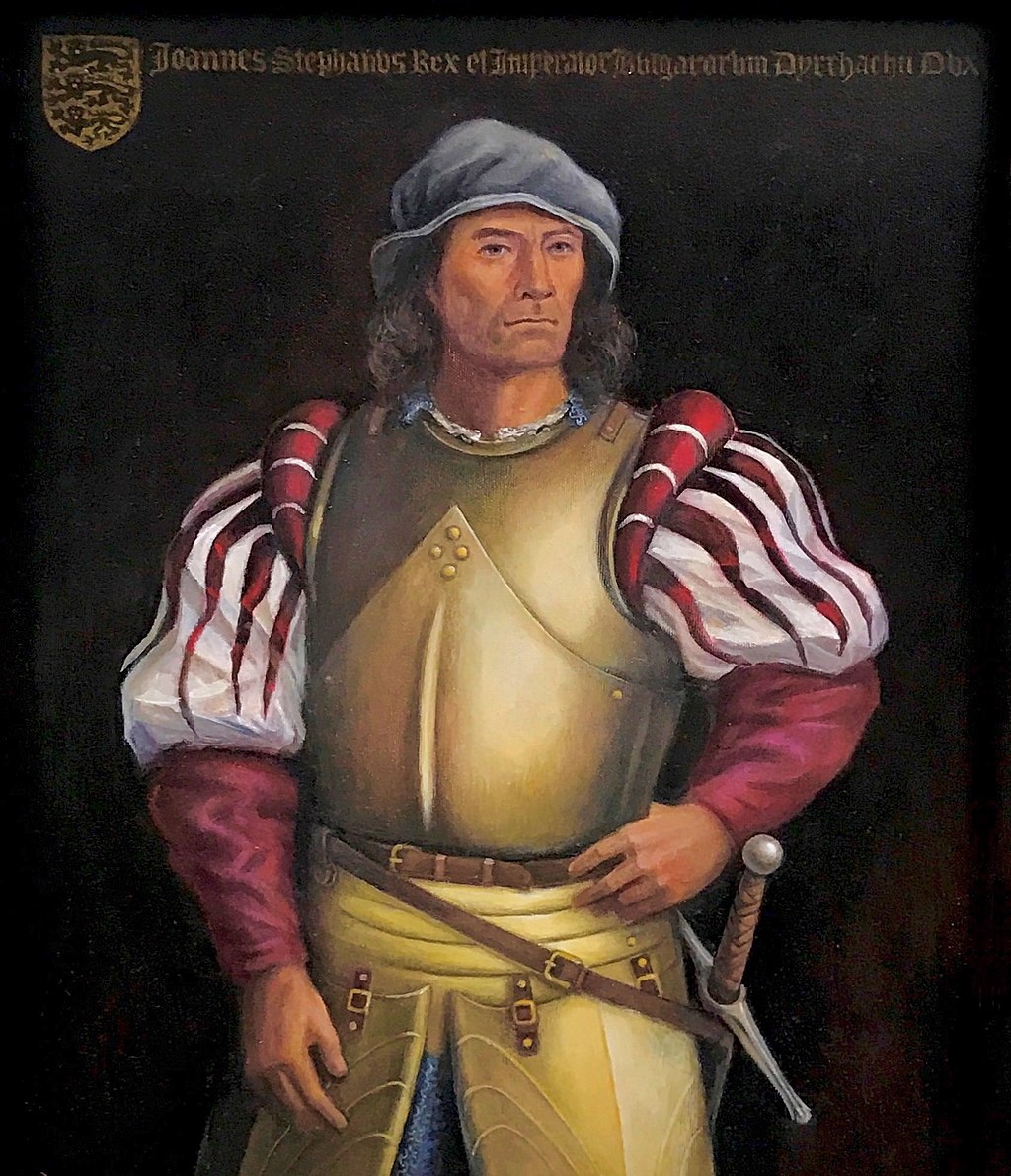
The uprising began in autumn 1185 after the consecration of a new church dedicated to St Demetrius. Theodore was proclaimed tsar and took the name Peter. The revolt soon spread throughout northern Bulgaria. The fighting culminated in 1190 at the Tryavna Pass, where the Bulgarian army defeated the Byzantines. Tarnovgrad was proclaimed the capital. Consolidation continued in the twelfth century, reaching its height under Tsar Kaloyan (1197–1207), the youngest brother of Asen and Peter.
Kaloyan sought to unite all Bulgarian lands and restore the state's political strength. To secure recognition of his royal authority, he opened contacts with Rome. During the Fourth Crusade in 1202, he engaged in active communication with Pope Innocent III. A papal delegation led by Cardinal Leo arrived in Tarnovo on 15 October 1204. On 8 November 1204, Kaloyan was officially crowned king, or rex, and received a sceptre and banner as tangible recognition of his authority. Archbishop Basil was declared primate of the Bulgarian Church.
In 1205, Kaloyan launched large-scale military operations in Thrace, Macedonia and the Rhodopes. In 1207, he and Cuman forces besieged Thessaloniki. Before the decisive assault, however, he was betrayed and killed by the Cuman commander Manastar following a boyar conspiracy. His nephew Boril headed the plot and took the Bulgarian throne after Kaloyan's death.
Under Boril (1207–1218), Bulgaria again lost territory, including Plovdiv, Belgrade, Braničevo and Niš. In 1217, Ivan Asen I's heir Ivan Asen II returned to Bulgaria with Sebastokrator Alexander. Boril attempted to strengthen his position in Tarnovo but was captured, and Ivan Asen II took the throne.
Ivan Asen II was known for skilful diplomacy, dynastic marriages and strong central authority. He made Bulgaria a powerful state. His foreign policy looked south towards Theodore Komnenos's expanding Despotate of Epirus. To secure peace, he concluded a treaty with Theodore, sealed by the marriage of Theodore's brother Manuel Komnenos to the Bulgarian ruler's daughter, Princess Maria. The appointment of Ivan Asen II as guardian of the young Byzantine emperor Baldwin II, however, heightened tensions between Bulgaria and Epirus. Theodore therefore launched a campaign against the Bulgarians as allies of the Latins. The battle took place on 9 March 1230 near the fortress of Klokotnitsa, close to present-day Haskovo. The Epirote army was routed and Theodore captured. After this victory, lands in Thrace, Macedonia, Wallachia and Albania joined Bulgaria. Its borders again reached three seas, restoring the strength of Simeon I's era. Bulgaria also gained considerable economic power, minting gold, silver and copper coins. Significant trading relations were established, documented in the Dubrovnik Charter of 1230. Tarnovo flourished materially and culturally.
Relations with the Latin Empire deteriorated in 1231 when John of Brienne, ruler of Jerusalem, was appointed guardian of the young Baldwin II. In 1232, the Hungarians, supported by the pope, invaded Belgrade, Braničevo and Vidin. This caused a break with the western Church and ended the union concluded by Kaloyan in 1204. The Bulgarian Patriarchate was restored at the Council of Lampsacus in 1235. To seal the alliance, the Nicaean emperor married Ivan Asen II's daughter Helena. In 1237, Ivan Asen II married Theodore Komnenos's daughter Irene, also securing peace with Epirus. The first Tatar raids from the east began during his reign. In 1241, he became the first to defeat one of their detachments. He died on 24 June 1241, leaving Bulgaria strengthened economically, territorially and politically.
After Ivan Asen II's death, political instability began in Bulgaria. Meanwhile, the Empire of Nicaea grew stronger, Tatar invasions continued and the Serbian principality's increasing military power became a threat to Bulgarian territory.
The throne was occupied by Kaliman I (1241–1246), Michael II Asen (1246–1256), Constantine Tikh Asen (1257–1277), Ivan Asen III (1278–1279), George Terter (1280–1292), Smilets (1292–1295), Theodore Svetoslav Terter (1295–1322) and George Terter (1322–1323). Their reigns were marked by internal instability and external military threats. One of the best-known uprisings to seize power was led by Ivaylo. In 1277, his peasant army rose in revolt and, after repelling Tatar raids, marched towards Tarnovo. Constantine Tikh tried to suppress it, but his army was defeated and he was killed. Under external pressure from Byzantium, Tarnovo's boyar aristocracy decided to marry the widowed tsarina to Ivaylo, accepting him as the legitimate Bulgarian ruler (1278–1280). The country's fragmentation continued under subsequent rulers.
With Ivan Alexander's accession (1331–1371), Bulgaria temporarily regained political stability. Despite military successes and achievements in cultural and spiritual life, its territory continued to fragment into feudal boyar domains, or despotates. Ivan Alexander himself contributed by deciding before his death to divide the empire between two sons. He entrusted his first son, Ivan Sratsimir, with the Principality of Vidin, which became a separate tsardom, and chose his second son, Ivan Shishman, as successor. The number of separate despotates also grew. Dejan in the Velbazhd region and Momchil in the Rhodopes gained almost complete independence. Dobrudja was ruled by descendants of the Terter dynasty, while Hrelyo controlled the area between Strumica, Štip and Rila Monastery. In this political situation, a new lasting threat to the Balkans emerged from the south: the Seljuk Turks. Byzantine emperors often used them to gain military strength. During the fourteenth century, however, the Turks increasingly sought to expand beyond Asia Minor and establish themselves on Europe's shore. In 1352, Sultan Süleyman captured the fortress of Tzympe, securing a permanent foothold in Europe. In less than ten years, the Turks captured substantial parts of Thrace, including Stara Zagora and Plovdiv.
Another external threat in the fourteenth century was the Hungarian kingdom's advance into the Balkans. Amid this complex situation, the Turks invaded Bulgaria in 1372 and captured the Danube fortress of Drastar in 1382. Despite joint military efforts by Bulgarians, Serbs, Vlachs and Bosnians, the Battle of Kosovo on 15 June 1389 played an important part in the Turkish conquest of the Balkans. After a prolonged siege, Tarnovo fell on 17 July 1393. Ivan Shishman continued to rule briefly from Nikopol. Only the Tsardom of Vidin remained, and it fell after the Battle of Nicopolis. This ended the Second Bulgarian Empire and began five centuries of Ottoman rule in the Bulgarian lands.
Share:


Rulers during this period