Tsar Theodore Svetoslav

Tsar Theodore Svetoslav
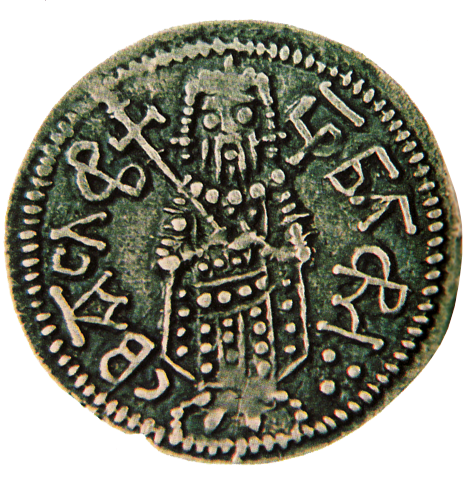
Theodore Svetoslav
Theodore Svetoslav Terter was born in the early 1270s as the son of George I Terter and Maria Terter. His name, "Svetoslav", has attracted interest: Professor Plamen Pavlov suggests that his mother Maria was a daughter of Jacob Svetoslav by his wife, an unnamed granddaughter of Ivan Asen II.
In 1279, with Byzantine assistance, Ivan Asen III ascended the throne in Tarnovo. His principal rival, George Terter, became his ally. Theodore Svetoslav and his mother were sent to Nicaea as Byzantine hostages.
After Ivan Asen III fled in 1280, George Terter seized the throne. Theodore Svetoslav remained imprisoned as a hostage. In 1284–1285, although still a captive, he became engaged to the daughter of the Thessalian sebastokrator John Angelos. The Bulgarian-Byzantine agreement of 1284 brought George I Terter's wife back, but Theodore Svetoslav remained a hostage.
After returning to Tarnovo, Svetoslav was proclaimed his father's co-ruler. Soon afterwards he was sent into captivity among the Tatars together with his sister. George I Terter acknowledged vassalage to the Golden Horde, which resulted in approximately 15 years of Tatar captivity for the tsar's son.
After Nogai's death, Svetoslav married Euphrosyne Palaiologina and, through his wife, attained a high position. A struggle for supremacy in the Golden Horde began between Chaka and Tokhtai. Chaka lost, and Svetoslav carried out Chaka's execution and sent his head to the khan in Crimea.
After Chaka's death, Theodore Svetoslav took power in Bulgaria and proclaimed himself tsar in 1300. He successfully settled relations with the Golden Horde and achieved territorial gains, including in Bessarabia.
The internal opposition to Svetoslav included the Tarnovo patriarch Joachim III, who was accused of supporting the Tatars. The tsar ordered the patriarch to be thrown from the wall of Tsarevets, thereby consolidating his rule.
Tsar Theodore Svetoslav Terter governed Bulgaria with skilful policies, achieving stabilisation and territorial successes. He is remembered as a ruler who overcame internal and external challenges, establishing himself as an important figure in Bulgarian history until his death in 1321.
Share:


