Aegean Thrace

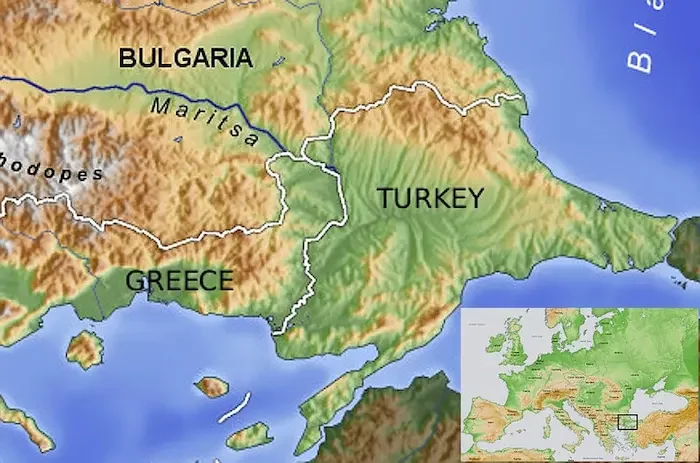
Aegean Thrace is a geographical and historical region in the southern Balkan Peninsula, along the shores of the Aegean Sea. It has witnessed numerous historical events and changes, passing over the centuries under the rule of various states and empires, including the Byzantine Empire, the Ottoman Empire and the Bulgarian states.
Following the Balkan Wars of 1912–1913, Aegean Thrace became part of the Bulgarian state. At that time, the region was organised administratively as the District of Gyumyurdzhina, comprising ten subdistricts. An important administrative measure was the opening of a Bulgarian customs office in Dedeagach (modern Alexandroupoli) in October 1913, with branches in the villages of Makri and Maronia. This customs office played a key role in the region's economic life and trade.
Within only a year of the Aegean region's incorporation into Bulgaria, by mid-1914, Bulgarian engineering teams had drawn up and implemented the first town-planning schemes. They laid out streets and regulated plot boundaries in many villages, establishing the foundations for modern administration and the development of settlements.
In 1915, the District of Edirne was also formed, centred on Karaağaç railway station in a suburb of Edirne. Under the convention with Turkey that year, Bulgaria acquired 2,588 square kilometres of territory containing more than 160 settlements, including the towns of Karaağaç, Didymoteicho and Kuleli. The railway to Dedeagach was an important strategic and economic asset, and both banks of the Maritsa at its mouth on the Aegean Sea also came under Bulgarian administration.
Aegean Thrace has been of key historical importance to the Bulgarian state and culture, as a bridge between Europe and Asia and an important gateway to the Aegean Sea. The influence of Bulgarian rulers and the administrative reforms of this period left a lasting mark on the territory's development and on the preservation of Bulgarian identity among its population.
Share:


