Tsar Ivan Alexander

Tsar Ivan Alexander
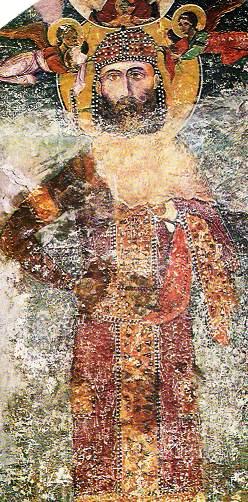
Ivan Alexander
Ivan Alexander was a Bulgarian tsar who ruled from 1331 to 1371. He was the son of Despot Sratsimir and Keratsa Petritsa, belonging on his father's side to Bulgaria's last medieval dynasty, the Shishmans, through its Sratsimir branch, and descending from the Asens on his mother's side.
He was born in the early fourteenth century, after his parents' marriage around 1300. Before becoming tsar in Tarnovo, he held the position of despot of Lovech.
His rise to royal power resulted from a coup in Tarnovo that overthrew Tsar Ivan Stephen (1330–1331), who had been placed on the Bulgarian throne by the Serbs after the Battle of Velbazhd in 1330. After securing the throne, Ivan Alexander established peaceful relations with the new Serbian king Stefan Dušan (1331–1355), who was Bulgarian on his mother's side. In 1333, Stefan Dušan married one of Tsar Ivan Alexander's sisters, Tsarina Elena of Bulgaria, thereby strengthening the ties between Bulgaria and Serbia.
Ivan Alexander ruled for 40 years, making his the second-longest reign after that of Tsar Peter I. He was among the most influential figures in the history of the Balkan Peninsula during the fourteenth century.
The first period of Ivan Alexander's reign was militarily successful. He fought Byzantium successfully, using Mongol mercenaries, and managed to reverse the consequences of the defeat by the Serbs at Velbazhd in 1330. At Rusokastro in 1332, Ivan Alexander recovered the lands between the River Tundzha and the Black Sea. In 1344 he exploited Byzantine civil strife to acquire the city of Plovdiv and eight fortresses in the Rhodope Mountains.
In the summer of 1341, a claimant to the Bulgarian throne, Shishman, the third son of Tsar Michael III Shishman Asen and Anna-Neda, appeared in Constantinople. Ivan Alexander demanded that he be handed over, but the Byzantine regent John Kantakouzenos threatened to send him by ship to Bdin, where he could obtain support. Ivan Alexander assembled an army and probably clashed with the Byzantine army near Adrianople, but a peace treaty was eventually signed.
In 1342, having freed himself from internal problems, Ivan Alexander helped Emperor Kantakouzenos besiege the fortress of Thessaloniki. He demanded that the Romans hand over the fortress to him and simultaneously called on the Serbian king Stefan Dušan to detain John Kantakouzenos. Ivan Alexander withdrew after Empress Anna of Savoy called on Umur Bey for assistance. This phase nevertheless highlights the weaknesses of Bulgarian foreign policy as it attempted to exploit rivalries within the Eastern Roman Empire for its own interests.
In 1344, Empress Anna of Savoy handed over a large part of Thrace and nine fortresses in the Rhodope Mountains to Ivan Alexander to secure his support against Kantakouzenos. This move strengthened Bulgaria's position in the region but also exposed the difficulties of governing a large territory.
In 1345, the Bulgarians witnessed their defeat by the Turks and Byzantines at the fortress of Burugrad. This moment marked the Ottoman advance into the Balkans, which would have a substantial impact on Bulgaria's future.
The silver coin of Ivan Alexander and his son Michael Asen testifies to their wealth and influence during this period. Despite the successes at the beginning of his rule, the final period of Ivan Alexander's reign was marked by internal and external difficulties, including territorial losses and attacks by the Hungarians and Savoyards.
After the deaths of his sons Ivan and Michael in 1349 and 1355, Ivan Alexander granted the Vidin region to his third son, Ivan Sratsimir. He divorced his first wife, Theodora Basarab, and married Theodora II, a Jewish woman from Tarnovo. Her son, Ivan Shishman, was designated heir to the Tarnovo Tsardom.
Despite the successful initial period, Ivan Alexander is remembered as the last Bulgarian ruler who managed to maintain relatively stable territorial unity before Bulgaria fell under Ottoman rule in the final decades of the fourteenth century.
Share:


