Pannonia

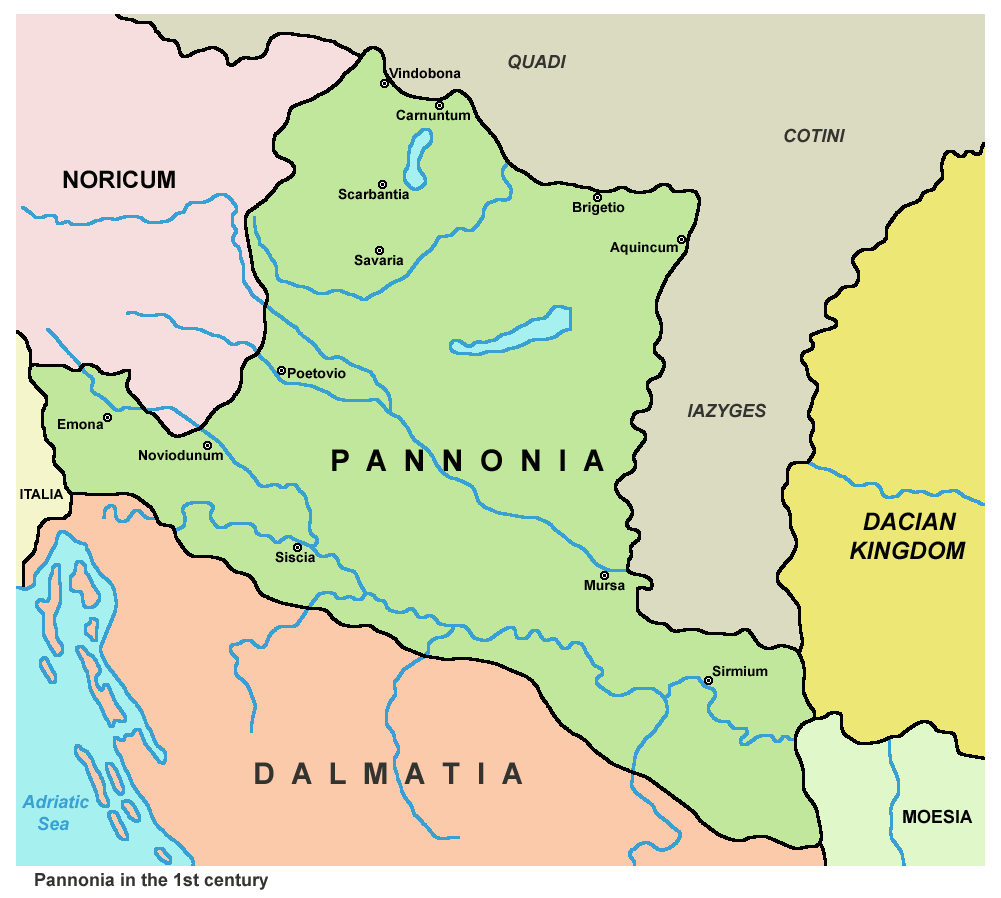
Pannonia is an ancient region in Central Europe, roughly corresponding to modern Hungary, eastern Austria, northern Croatia, western Serbia and parts of Slovenia. For centuries, it was a strategic crossroads between the barbarian world and Roman civilisation, and between the Latin West and the Slavic and Turkic East.
As early as the first century BC, the Romans turned their attention to this strategically situated, resource-rich region. Following a series of campaigns, Pannonia was fully incorporated within the Roman Empire in AD 9, under Emperor Octavian Augustus. It was organised as a province in AD 10 and, under Emperor Trajan around 103, divided into Upper and Lower Pannonia (Pannonia Superior and Inferior).
Pannonia flourished as part of Rome, with roads, aqueducts, theatres and fortified towns. One of its most important cities was Singidunum, modern Belgrade, along with Aquincum, near modern Budapest, where a legionary camp was stationed.
After the final division of the Roman Empire in 395, Pannonia came under the control of the Eastern Byzantine Empire. Weak control and barbarian invasions, however, undermined its influence in the region. In the fifth century, the Huns under Attila established a short-lived dominion of their own.
In the seventh century, Pannonia came under the influence of Kuber's Bulgars. Kuber led a large group of Bulgars, Avars and Slavs from Macedonia towards Pannonia and Sirmium, modern Srem.
Until the thirteenth century, Pannonia remained the scene of numerous cultural and military clashes between Byzantines, Franks, Bulgarians, Magyars and Slavs. In 1240, with the Tatar invasions and the weakening of Byzantium, the region finally passed into the hands of the Kingdom of Hungary, losing its old name and significance.
Share:


