Battle of Rusokastro

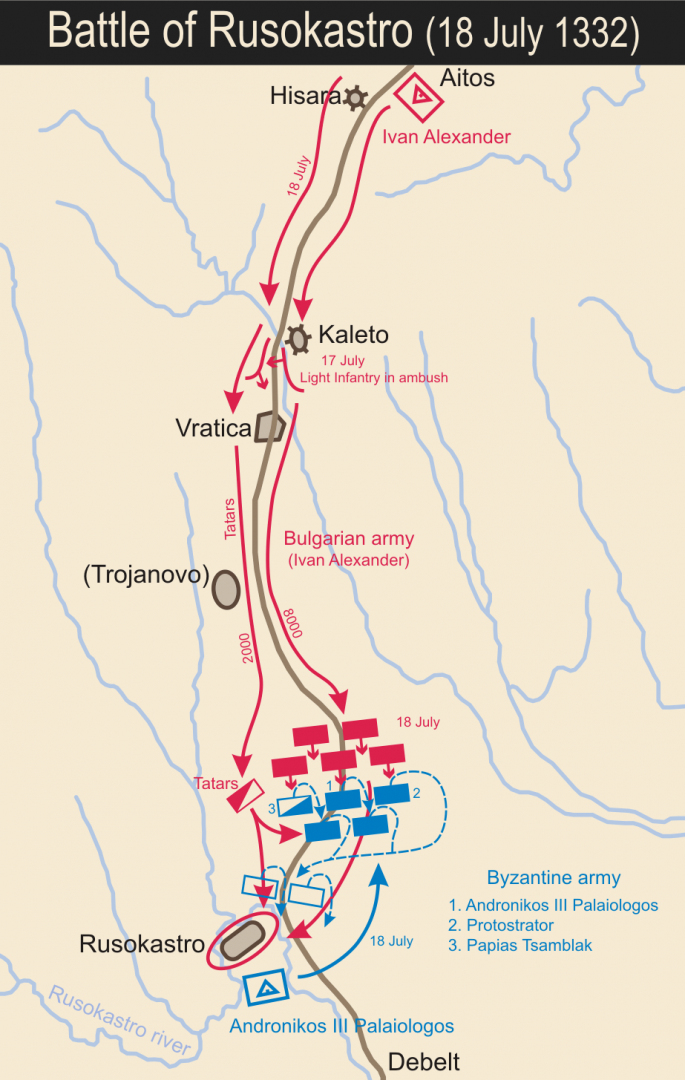
Battle of Rusokastro
In the summer of 1332, a rebellion broke out in Bulgarian territory under the boyar Belaur, brother of Michael III Shishman. At this time, the Byzantine emperor Andronikos III saw an opportunity to recover the fortresses south of the Balkan Mountains by exploiting the unrest in the neighbouring state. In the second half of June 1332, Andronikos III assembled an army and invaded Bulgaria.
Occupied with suppressing the rebellion, the Bulgarian tsar was initially unable to confront the Byzantine army. He began negotiations to end the hostilities. After assembling a large army, however, he advanced south of the Balkan Mountains and reached the vicinity of the fortress of Rusokastron, where the Byzantine emperor's troops were also stationed.
Negotiations between the two rulers led to an agreement on 17 July. Under its terms, Byzantium agreed to cede Diampolis (Yambol) to Bulgaria in exchange for Anchialos. During the night of 17 July, however, Tatar mercenaries summoned by the Bulgarian tsar Ivan Alexander arrived in the Bulgarian camp. He decided to attack so that he could subsequently negotiate from a position of strength.
As a result of the negotiations, the Byzantines left the occupied areas, and the towns between the Tundzha River and the Black Sea returned within the borders of the Bulgarian state. Ivan Alexander's eight-year-old son and heir to the Bulgarian throne, Michael Asen, was betrothed to Maria, the daughter of the Byzantine emperor Andronikos III. This political alliance strengthened relations between the two states and demonstrated their desire for lasting peace.
Share:


