The April Uprising

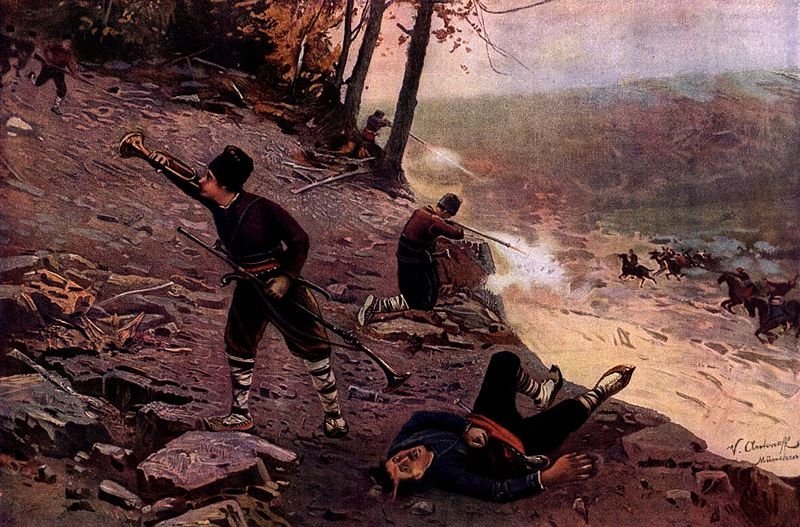
The April Uprising
The Stara Zagora Uprising of 1185 clearly showed that the Bulgarian people had reached the point of uniting their forces and conducting larger-scale military action against the Ottoman Empire, expressed in the extensive April Uprising of 1876. The Giurgiu Revolutionary Committee undertook its organisation and preparation. According to the committee's plan, the Bulgarian territories were divided into five revolutionary districts. The first was Tarnovo, centred on Gorna Oryahovitsa, with Stefan Stambolov as chief revolutionary organiser, or apostle, supported by Hristo Karaminkov, Ivan Panov Semerdzhiev and Georgi Izmirliev. Sliven was designated the second district, with Ilarion Dragostinov as chief apostle and Stoil Voivode and Georgi Obretenov as his assistants. Vratsa was the third centre. Its chief apostle, Stoyan Zaimov, was assisted by Nikola Obretenov, Georgi Apostolov and Nikola Slavkov. The Plovdiv district had Panayot Volov as chief apostle, with Georgi Benkovski, Georgi Ikonomov and Zahari Stoyanov as assistants. The final centre was Sofia, which in practice remained only a plan; Nikola Obretenov and Nikola Slavkov were appointed its apostles.
Preparation for the uprising lasted around two months. It received no external support. Serious military preparations took place only in the Tarnovo and Plovdiv districts. Obtaining weapons was a major problem in every district. Storehouses and fortified camps were prepared, chiefly in mountainous areas. The committees' assembly at Oborishte on 14 April 1876 drew up a plan for the uprising and set 1 May as the beginning of mass organised action. When Ottoman police attempted to arrest Todor Kableshkov, chairman of the Koprivshtitsa committee, the uprising broke out unexpectedly on 20 April, with the famous “Bloody Letter” regarded as its impetus. The uprising then spread to Panagyurishte and subsequently Tarnovo. The committees in the Vratsa district acted cautiously and decided to await Hristo Botev's detachment. On 16 May, the detachment led by Botev disembarked from the steamship Radetzky at Kozloduy. On 20 May, Hristo Botev was suddenly killed. The detachment split into separate armed groups, which were defeated one by one. Amid these setbacks, the April Uprising was suppressed.
The April Uprising of 1876 gave Russia grounds to begin exerting decisive pressure on the Ottoman Empire. At the end of 1876, an Office for the Civil Administration of the Lands Liberated beyond the Danube was established.
Share:


