Treaty of Bucharest

Treaty of Bucharest
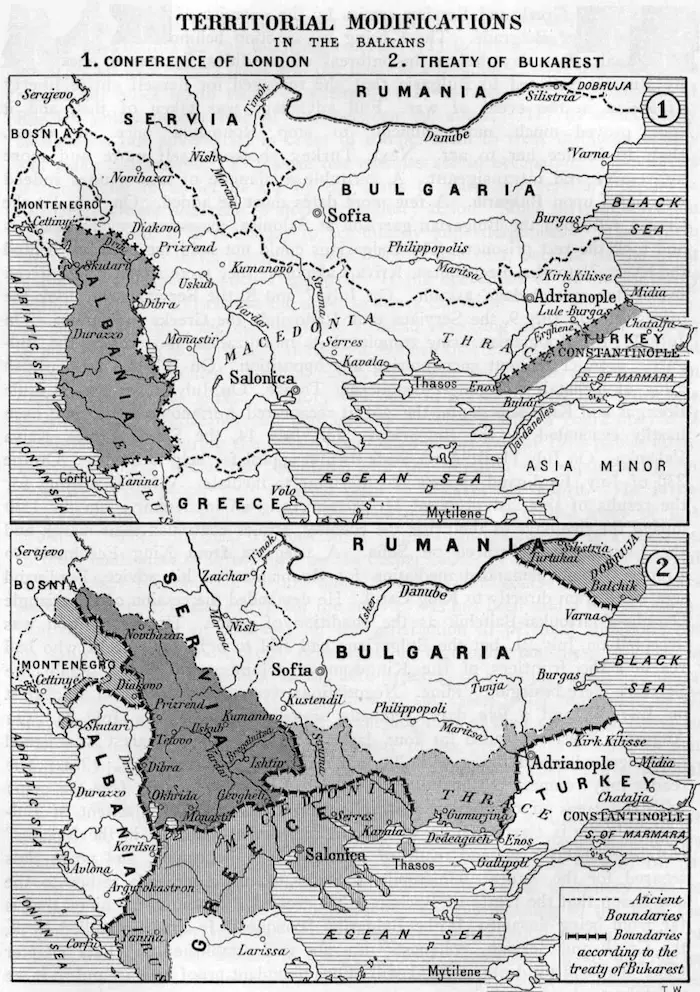
The Treaty of Bucharest was signed on 10 August 1913, ending the Second Balkan War, also known as the Inter-Allied War (29 June–10 August 1913). The conflict broke out after the unjust division of territories conquered by the Balkan League in the First Balkan War. Bulgaria, ruled by Tsar Ferdinand I of Saxe-Coburg and Gotha, was dissatisfied with the outcome of the Treaty of London and entered into conflict with its former allies, Serbia and Greece. Romania and the Ottoman Empire intervened in the conflict to improve their territorial positions.
The Treaty of Bucharest drew the region’s boundaries, substantially changing the map of the Balkans. Bulgaria lost much of Macedonia, which Serbia and Greece divided between them. Serbia received most of Macedonia, while Greece expanded its influence in Aegean Macedonia and Thessaly. Southern Dobruja was given to Romania as a reward, while the Ottoman Empire recovered some of its lost territories in Thrace.
Share:


