Prince Ferdinand I of Saxe-Coburg and Gotha

Prince Ferdinand I of Saxe-Coburg and Gotha
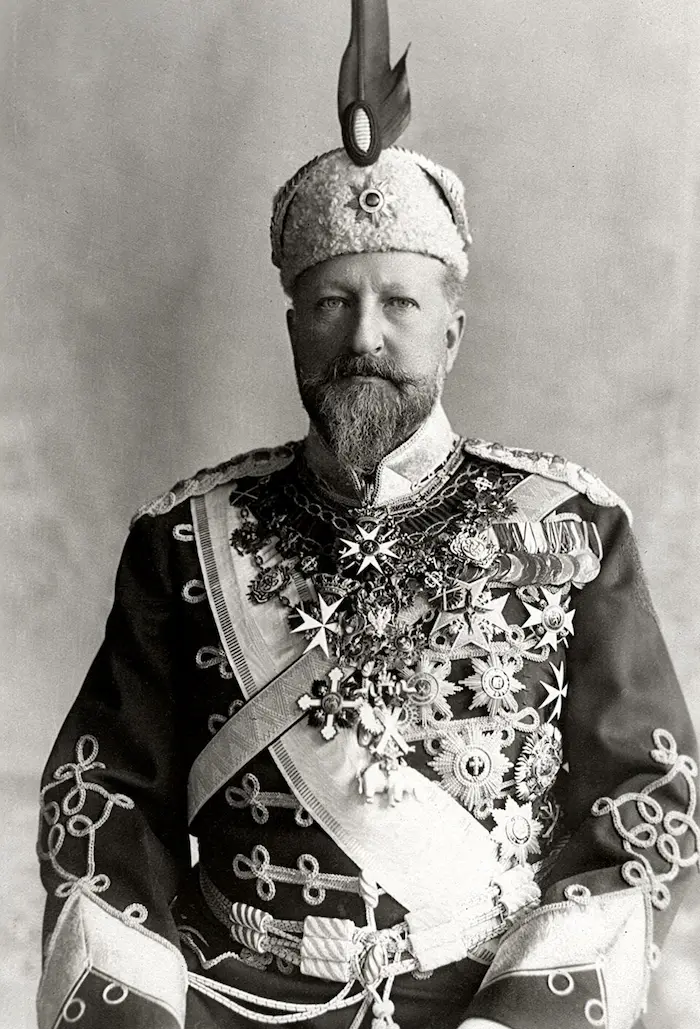
Ferdinand I of Saxe-Coburg and Gotha
Ferdinand I of Saxe-Coburg and Gotha (1861–1948) was a pivotal figure in Bulgarian history: first a prince and later a tsar, whose career encompassed both success and failure. Born into the noble house of Saxe-Coburg and Gotha, he took the Bulgarian throne in 1887 during a particularly difficult political period.
He was born on 26 February 1861 at Coburg Palace, described in the source as being in present-day Germany, the second son of Prince August of Saxe-Coburg and Gotha and Princess Clémentine of Orléans, daughter of the French king Louis Philippe. He grew up in European aristocratic culture, with strong interests in science, botany, military strategy and the arts.
After Alexander of Battenberg's removal and several years of instability, the Grand National Assembly elected Ferdinand Prince of Bulgaria on 7 July 1887. The Great Powers, including Russia, initially withheld recognition, but he showed flexibility and patience. In 1896, he secured ecclesiastical recognition by agreeing, against his personal convictions, to have his firstborn son Boris received into the Orthodox faith.
The defining act of his reign came on 22 September 1908, when he proclaimed Bulgaria's full independence from the Ottoman Empire and assumed the title Tsar of the Bulgarians. This established Bulgaria as an independent political actor in the Balkans.
Under Ferdinand, Bulgaria fought the Balkan Wars of 1912–1913. The first brought territorial gains; the second ended in a national catastrophe. Convinced of his role as a Balkan monarch and statesman, he also brought Bulgaria into the First World War on the Central Powers' side in 1915–1918. These military ambitions ended in another defeat, capitulation and widespread domestic discontent.
On 3 October 1918, described in the source as after the end of the First World War, Ferdinand abdicated in favour of Boris III and left Bulgaria. He spent the rest of his life in exile, chiefly in Coburg, Germany, and died on 10 September 1948.
He is often viewed as a ruler caught between Western aristocratic culture and Balkan realities. Despite his mistakes, he played an important role in establishing modern Bulgaria in the early twentieth century.
A surviving portrait of Ferdinand I is drawn from the Wikimedia Commons archive, where it is available in the public domain.
Share:


