Byzantine–Bulgarian Treaty of 815

Byzantine–Bulgarian Treaty of 815
The beginning of the 9th century presented considerable challenges to the two greatest powers on the Balkan Peninsula: Bulgaria and the Byzantine Empire. After a series of severe conflicts and political upheavals, a peace treaty was concluded in 815, confirming the borders, easing tensions and laying the foundations for regional stability.
In 811, Byzantium suffered a catastrophic defeat at the Battle of the Varbitsa Pass, where Emperor Nikephoros I was killed fighting the Bulgarians led by Khan Krum. His loss weakened the Byzantine Empire and created serious problems for its government.
After Krum’s death in 814, his son Omurtag took power in Bulgaria. He inherited both the country’s strong position and the need to settle relations with Byzantium to secure peace and safety for the future.
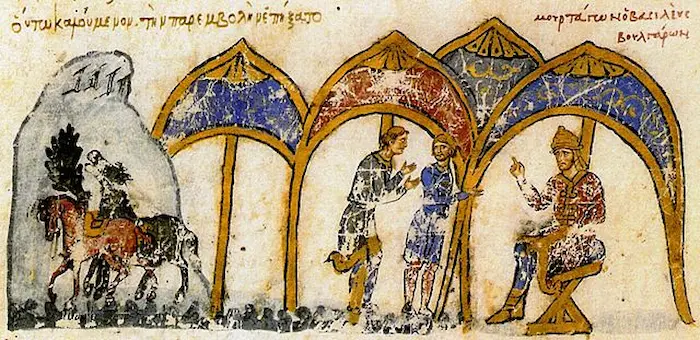
Early in 815, Khan Omurtag sent an official delegation and emissaries to Constantinople to negotiate peace with Emperor Leo V. The signing ceremony was solemn and took place in the presence of numerous witnesses and officials.
A notable and controversial ritual involved the Byzantine emperor swearing an oath according to Bulgarian pagan customs: pouring water onto the ground, turning over horse saddles and performing other symbolic acts that Byzantine chroniclers considered humiliating and even shocking for the Roman ruler. The surviving parts of the treaty are recorded in the Süleymanköy inscription, now kept at the National Archaeological Institute in Sofia.
The boundary between Bulgaria and Byzantium began at Debelt on the Black Sea and followed the old Erkesia trench towards the upper reaches of the Choban Azmak River. It continued towards the Maritsa north of Harmanli, near the ancient town of Constantia, and reached the village of Uzundzhovo. The border then reached a mountain, probably in the Eastern Rhodopes, where it was officially ratified. Bulgaria thus received formal recognition of its southward expansion, including the gradual annexation of the areas around Philippopolis (present-day Plovdiv). In return, the Bulgarians handed back certain fortresses near Adrianople to Byzantium.
The Bulgarians undertook to release Byzantine prisoners captured during the war of 811 and Krum’s subsequent raids. Byzantium, in turn, released captured Slavs from the border areas, even if some had never been its subjects. In addition, the empire had to pay two head of livestock for each released Byzantine soldier, ensuring economic compensation for Bulgaria and reducing the Byzantine garrisons along the border.
Although the treaty favoured Bulgaria, it gave both sides a respite after exhausting military conflicts. Byzantium needed to recover from its defeats and internal religious struggles associated with the revival of iconoclasm, while Bulgaria faced internal religious problems. Omurtag began anti-Christian persecutions, and his son Enravota became one of their victims.
Bulgaria’s economy also needed to recover after the destructive wars, and the capital, Pliska, still lay in ruins. The peace treaty allowed Omurtag to concentrate on strengthening the state internally through administrative reforms, construction and economic development.
In 820, the treaty was reaffirmed with the new Byzantine emperor Michael II. He and Omurtag agreed to provide mutual assistance against threats, as demonstrated in 823 when Omurtag successfully lifted the siege of Constantinople by the rebel Thomas the Slav, supporting the Byzantine throne.
An illustration of the Bulgarian delegation sent by Khan Omurtag to Constantinople to sign the peace treaty with Byzantium in 815. The image is taken from Wikimedia Commons and is in the public domain.
Share:


