Revolutionary Zahari Stoyanov

Revolutionary Zahari Stoyanov
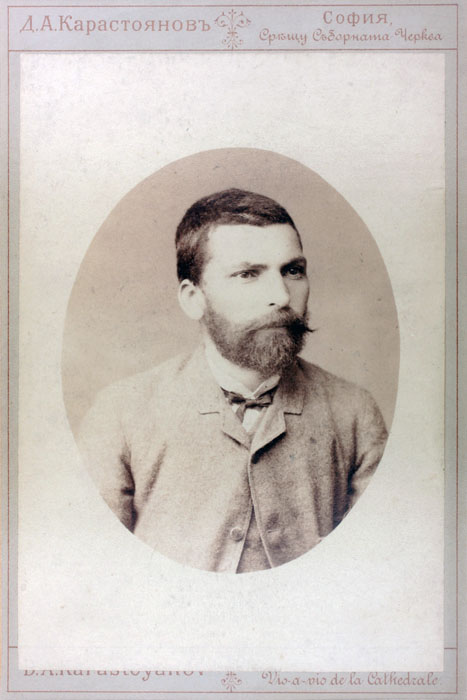
Zahari Stoyanov

Zahari Stoyanov, born Dzhendo Stoyanov Dzhedev, was a Bulgarian revolutionary, politician, journalist and writer. He is known for his participation as an assistant apostle, or revolutionary organiser, in the April Uprising of 1876 and as author of the book "Notes on the Bulgarian Uprisings". He was president of the Bulgarian Commercial-Revolutionary Central Committee (BTCRK) and a key organiser of the Unification of the Principality of Bulgaria and Eastern Rumelia in 1885. He was also an active member of the People's Liberal, or Stambolovist, Party and an established Freemason. He was born in 1850 into the family of the shepherd Stoyan Dzhedev Dalakchiev from the village of Medven in the Kotel region and was named Dzhendo. He attended the church school and class school in his native village between 1856 and 1862.
He worked as a shepherd in various villages, including Indzhekyoy, now Topoli, and Podvis in the Karnobat region (1866–1870). After difficulties in his attempts to study at the secular school in Varna, Zahari Stoyanov went to Ruse. There he joined the Ruse Local Revolutionary Committee of the Internal Revolutionary Organisation (IRO) in 1871–1872. In 1873 he became a clerk and shunter on Baron Hirsch's railway at Tarnovo-Seymen station, now Simeonovgrad.
In 1875 he participated in the Stara Zagora Uprising and successfully escaped pursuit with the help of the conductor K. Teodorov. Because of his involvement in the uprising, he was hidden in Harmanli by the railway stationmaster, Radi Ivanov, between 9 October 1875 and 1 March 1876.
During the April Uprising of 1876, Zahari Stoyanov became a leader in the Fourth Plovdiv Revolutionary District and a member of Benkovski's Flying Detachment. After the uprising was crushed, when Georgi Benkovski, Father Kiril and Stefo the Dalmatian were captured, Zahari managed to escape but was later arrested near Terziysko in the Troyan region. Under questioning, he denied his insurgent activity, presenting himself as a Roma man accused of rebellion.
In 1877, after months in various prisons, he secretly went to the liberated town of Tarnovo.
Share:


