Revolutionary Petar Darvingov

Revolutionary Petar Darvingov
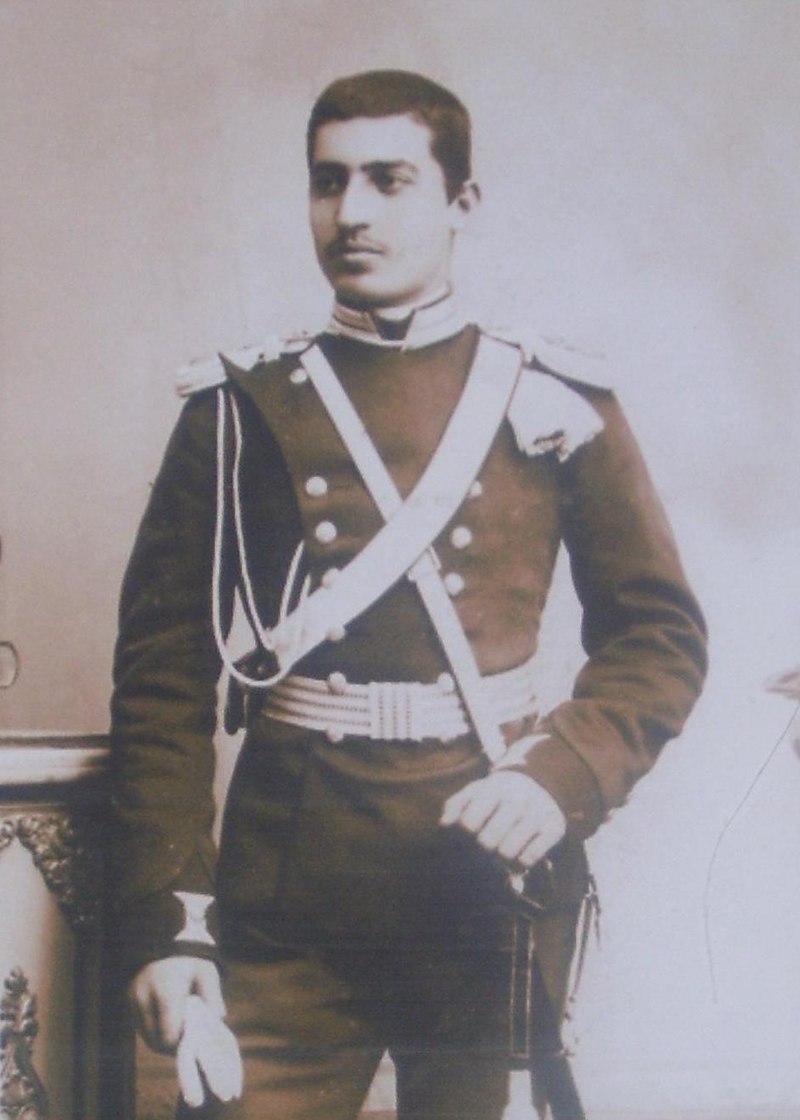
Petar Darvingov
Petar Georgiev Darvingov was a Bulgarian officer, revolutionary and military historian. He was born on 24 December 1883 in Belatsite, in present-day North Macedonia. He was a colonel in the General Staff service, a revolutionary voivode of the Supreme Macedonian-Adrianople Committee and a military historian. He was also a corresponding member of the Bulgarian Academy of Sciences from 1932.
In 1902, before the Gorna Dzhumaya Uprising, Darvingov took his regular leave and applied to enter the reserve. He participated in the uprising as a member of the insurgent staff and commanded a detachment.
During the Ilinden Uprising of 1903, he was a military organiser of the Internal Organisation's detachments and fought in the Melnik region.
After the uprisings, he returned to Bulgaria and entered active military service in the 3rd Cavalry Regiment. In 1909 he graduated from the Military Academy in Turin, Italy. He then returned to service in the 3rd Cavalry Regiment.
In 1910–1912, together with other officers, he became a leader of the revolutionary group of activists belonging to the former Supreme Committee.
In 1911 he became an instructor at the Military School and was assigned to the General Staff. In 1912 he was appointed assistant head of the Intelligence Section at Army Headquarters.
During the First World War, Darvingov organised and served as chief of staff of the Eleventh Macedonian Infantry Division. He actively participated in military operations and led the Macedonian-Adrianople Volunteer Corps. In 1915 he was promoted to colonel.
After the war, in 1918, he held various military and administrative posts. He continued serving in the army as a regimental and brigade commander in 1918–1919.
Petar Georgiev Darvingov also participated in the Second World War, when he was chief of the general staff of the 5th Army.
After the war, in 1946, he was arrested by the communist authorities and sentenced to death, with his execution carried out on 30 November 1946 in Sofia. The order for his execution was overturned in 1996, and he was rehabilitated in 2003.
Share:


