Kan Kubrat

Kan Kubrat
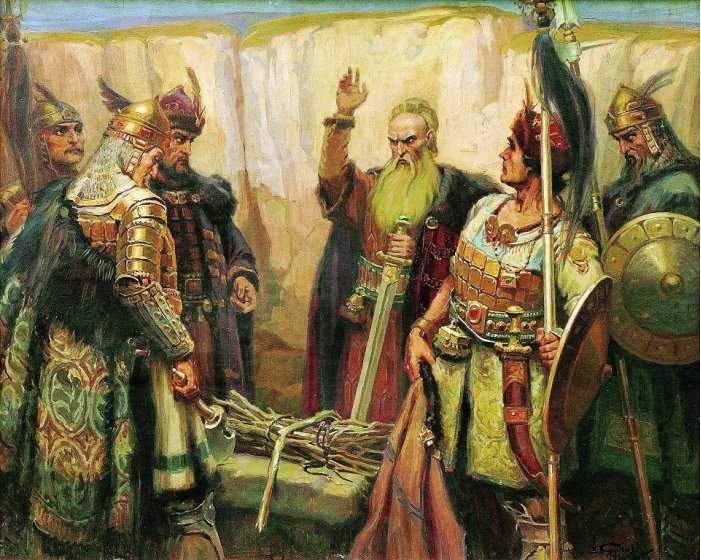
Kubrat
Kan Kubrat (also Krovat, Kurt, Hor Bat, Kuvrat or Kurdbard; in Greek: Χουβρατις, Κροβατον, Κουβρατος) is one of the most significant figures in early Bulgarian history. He founded Old Great Bulgaria, the first state union of the Bulgar tribes, which emerged in the seventh century. His name is associated with the beginning of Bulgarian statehood.
Kubrat's birth year has not been established precisely. Some authors place it around 585, although he was more probably born in 605 or 606. Kubrat came from the noble Dulo clan, which had ruled the Bulgars for generations. He belonged to the Unogundur tribe, one of the principal Bulgar clans, presumed to have been of Iranian origin. His full name was Kurt-Kubrat: "Kurt" means "wolf", while "Kubrat" means "proud". His father was the ruler Alburi, and his uncle Organa acted as regent for a time.
As a child, Kubrat was sent to Constantinople, where he received an education at the Byzantine emperor's court. There he became acquainted with the Christian religion and converted to Christianity. According to some sources this happened in 619, and according to others in 635. He studied alongside the future emperor Heraclius.
After his father's death, his uncle Organa proposed Kubrat as ruler. As the son of a ruler and a convert to Christianity, Kubrat became kan of the Bulgars, with his title also recognised by Byzantium. Emperor Heraclius bestowed on him the title of patrician, a rare distinction for a barbarian ruler.
At the beginning of the seventh century, the Bulgar tribes had been subject to the powerful Turkic Khaganate for about 70 years. Kubrat fought successful wars against it and freed the Bulgar tribes from its rule. After these victories, he began uniting the scattered Bulgar clans into an independent state.
Around 632, Kubrat succeeded in uniting the Bulgars and established the state that Byzantine chroniclers called Old Great Bulgaria, or Onoguria. It encompassed the territory between the River Kuban in the east, the Dnieper in the west, the Black Sea and Sea of Azov in the south, and the Donets in the north.
Old Great Bulgaria was a military and tribal union divided into administrative and military districts. Central authority lay with the kan, but the different districts were governed by members of the Dulo clan: Kubrat's five sons. Each played an important role in governing and defending the state.
Kubrat maintained peaceful relations with Byzantium, including a formal peace treaty in 635. Great Bulgaria was powerful and stable. Trade, military affairs, medicine, construction and spiritual life developed. Christianity existed alongside traditional beliefs, and Kubrat was respected in the East and in Constantinople.
Kan Kubrat died around 663–668 near present-day Poltava in Ukraine, in the area of Mala Pereshchepina, where his rich treasure was discovered. The Pereshchepina treasure contains more than 800 gold and silver objects, including swords and Byzantine gifts. According to legend, before his death he gathered his sons and showed them a bundle of sticks that were easily broken separately but could not be broken together. This symbolised strength in unity and conveyed his final wish that they preserve the state together.
After Kubrat's death, the union of the tribes did not survive. Each of his sons took a different path. The most successful was Asparuh, who established Danubian Bulgaria in 681, officially recognised by Byzantium. Nevertheless, Kubrat's achievement remains at the foundation of Bulgarian statehood and ranks among the most important events of the early Middle Ages.
Share:


