Revolutionary Anton Prudkin

Revolutionary Anton Prudkin
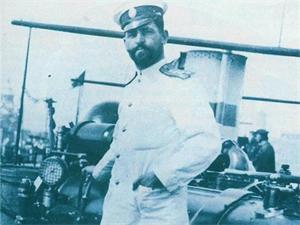
Anton Prudkin
Anton Makarovich Prudkin was a Bulgarian revolutionary, sea captain, adventurer, anarchist, spy, writer and artist.
Anton Prudkin completed primary and secondary education in Svishtov, then graduated from the Maritime School in Mykolaiv in the Russian Empire. In 1900 he returned to Bulgaria and served as assistant captain of the ship "Boris" until October 1902. That same year he became an agent of the Russian political police, the Okhrana, using the pseudonyms "Ozerov" and "Takvaryan". He also sympathised with the Macedonian and Armenian liberation movements and was a member of the Bulgarian Workers' Social Democratic Party (BWSDP). In 1902 he participated in an unsuccessful assassination attempt against Sultan Abdul Hamid II.
In 1903, with a group of anarchists from the Internal Macedonian-Adrianople Revolutionary Organisation, he organised a series of attacks against the Ottoman Empire. He attracted the attention of the Great Powers, which pressured Bulgaria to identify the perpetrators. His attack plans were foiled, and he fled to Switzerland.
In 1906 he organised the first sailors' strike and introduced industrial dolphin hunting in the Black Sea. With Naum Tyufekchiev, he organised arms shipments between Bulgaria and Russia. He participated in the First and Second Balkan Wars. After Bulgaria entered the First World War, he was arrested for military espionage on behalf of Russia. In fact, he had participated in passing military information to Russian intelligence. Charges and a sentence of life imprisonment followed.
In prison he met Alexander Stamboliyski, leader of the Bulgarian Agrarian National Union. In 1918, after the war ended, he was released and appointed police chief and city governor in Sofia. He participated in freeing IMRO's leaders, which brought him into conflict with Konstantin Muraviev. In 1920 he was forced to leave his posts.
That same year he directed the bombing of the overpass in Nadezhda. In 1923 he was arrested after the 9 June coup, and in 1925 he was sentenced to death for involvement in the attack at the Odeon Theatre. His sentence was not carried out, and in 1930 he was sentenced to life imprisonment. In 1936 he was pardoned and released.
After his release he moved to Varna and served as captain of the ship "Rudnichar". In 1942 he prepared an attack but was captured, sentenced to death and executed on 1 August 1942. In 1969 he received a posthumous award from the USSR. A novel about him was published in 1985, and in May 1941 he made two voyages to Palestine, carrying about 1,200 Bulgarian Jews.
Share:


