Treaty of Neuilly

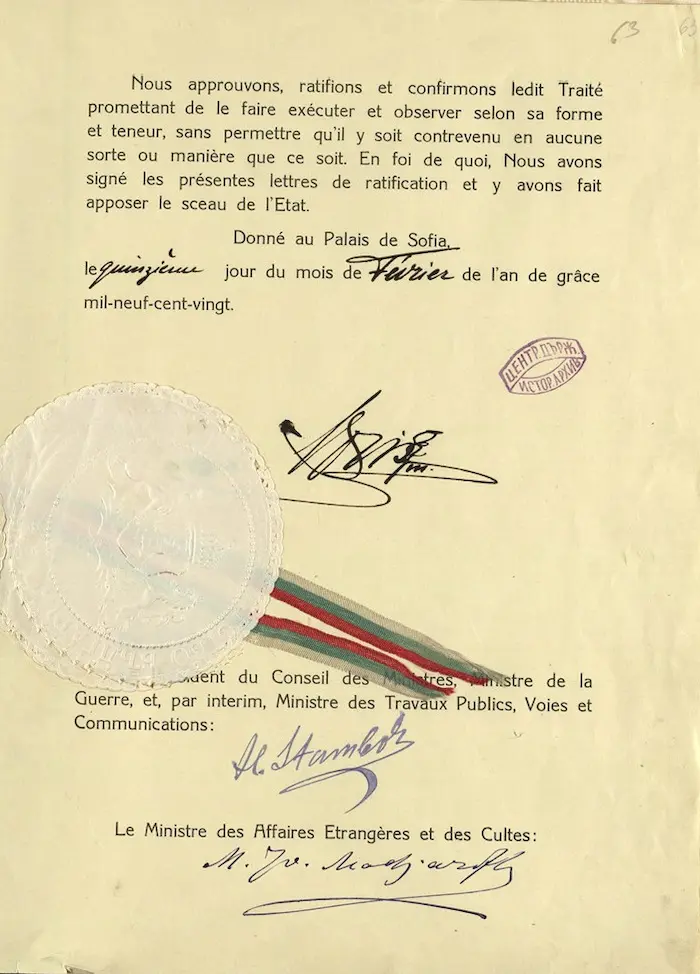
Treaty of Neuilly
The Treaty of Neuilly was signed on 27 November 1919 in the Paris suburb of Neuilly-sur-Seine. It ended the Kingdom of Bulgaria’s participation in the First World War. Defeated and isolated, Bulgaria was forced to accept harsh conditions imposed by the victorious Entente powers.
The treaty was signed by Bulgarian Prime Minister Aleksandar Stamboliyski and representatives of France, Great Britain, Italy, Japan and the United States, with French Foreign Minister Stephen Pichon playing a leading role.
Bulgaria lost Western Thrace, which passed to Greece; Southern Dobruja, which remained with Romania; and the Western Outlands, which passed to the Kingdom of Serbs, Croats and Slovenes. The country was required to pay reparations exceeding two billion gold francs and to limit its army to 20,000 men, without heavy weapons.
The Treaty of Neuilly was regarded as a national catastrophe. It intensified political and social tensions in the country, triggered waves of refugees and encouraged nationalist movements. Opposition representatives accused the Bulgarian delegates of failing to negotiate more favourable peace terms. Critical articles in the press claimed that the delegation had behaved in a humiliating manner instead of emphasising that Bulgaria had sided with the Central Powers because they alone had guaranteed its national unification. According to Stoyan Mihaylov, the country had been drawn into the war against its will. The treaty’s consequences left a deep imprint on Bulgarian history throughout the 20th century.
Share:


