Treaty of Berlin

Treaty of Berlin
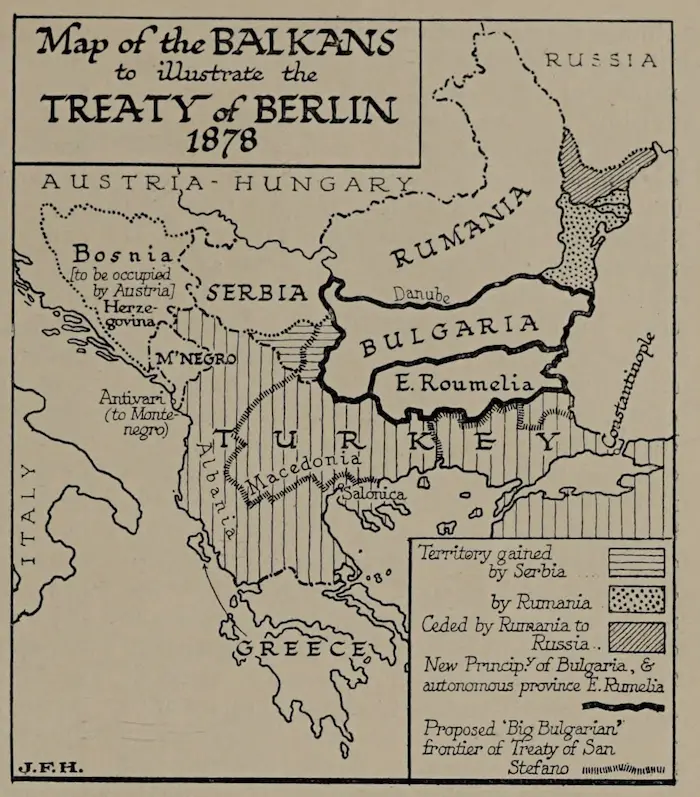
After the end of the Russo-Turkish War (1877–1878), a treaty was signed at the Radziwiłł Palace on 13 July 1878, revising the preliminary agreement reached at San Stefano on 3 March that year. The Treaty of San Stefano had envisaged a large, autonomous Bulgarian state, but this caused serious concern among the Great Powers, particularly Great Britain and Austria-Hungary, which feared Russia’s growing influence in the Balkans.
Under the chairmanship of German Chancellor Otto von Bismarck, the Congress of Berlin drew new boundaries in the Balkans. It created the Principality of Bulgaria, autonomous but a vassal of the Ottoman Empire, with considerably smaller territories around the Danube. The province of Eastern Rumelia also remained autonomous but still Ottoman. The remaining Bulgarian lands, including Macedonia and Thrace, stayed under Ottoman rule.
The Treaty of Berlin reshaped the national ideal and marked the beginning of a long and complex struggle for Bulgarian unification. The people regarded it as an unjust restriction on national aspirations, leading to prolonged tensions and conflicts, particularly in Bulgarian lands such as Macedonia that remained under Ottoman rule.
Share:


