Revolutionary Panayot Hitov

Revolutionary Panayot Hitov
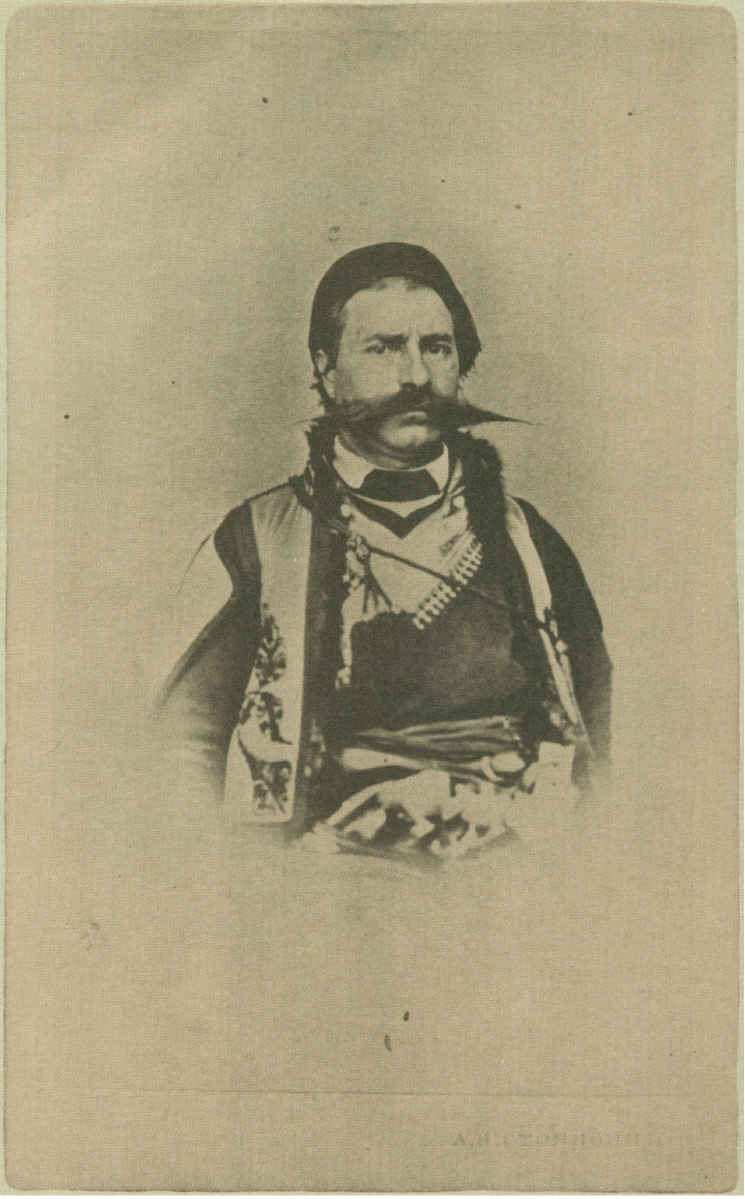
Panayot Hitov
Panayot Ivanov Hitov (11 November 1830–22 February 1918) was a renowned Bulgarian hajduk, national revolutionary and leader of revolutionary detachments during the revolutionary events in Bulgaria.
Hitov was born on 11 November 1830 in the Novo Selo quarter of Sliven. His parents were Saba and Ivan, a wealthy livestock breeder. Besides helping his father and his brother Hristo with the flock at the Tiled House, situated in the Sinite Kamani area near Sliven, Panayot traded livestock and worked as a butcher and grocer. In 1854 he married Boyka Lyutskanova, with whom he had a son named Stefan. His wife died after 12 years of marriage. In 1874 he married again in Belgrade, to Ekaterina Branković, with whom he had two sons, Simeon and Alexander, and a daughter, Irina.
In 1858, Hitov joined Georgi Trankin's detachment as a hajduk. After Trankin's death in 1860, Hitov was elected the detachment's voivode. He became an active participant in revolutionary events in south-eastern Bulgaria and worked with other well-known voivodes, such as Hadzhi Dimitar, Stoyan Papazov and Dyado Zhelyu.
In 1864–1865, influenced by revolutionary ideas, Hitov began to view his activities as part of the nationwide liberation movement. He maintained contact with Georgi Rakovski and recruited detachment members among the Bulgarians in Kragujevac. Under Rakovski's plan, Hitov was designated chief Bulgarian voivode. On 28 April 1867, Hitov crossed the Danube near Tutrakan with a detachment of about 30 men. Vasil Levski was its standard-bearer. Hitov's objective was to carry out a revolutionary march to rally the Bulgarian population rather than to provoke an uprising.
After withdrawing to Serbia, Hitov received a pension from the Serbian government and embraced the idea of an alliance between the Bulgarian and Serbian liberation movements. In 1869–1871, Hitov exchanged views with Vasil Levski, expressing support for the idea of unification.
In the summer of 1871, Hitov signed an agreement with the Montenegrin voivode Matanović for simultaneous uprisings in various regions, including Bulgaria. He became a member of the BRCC in 1872.
As the voivode of a Bulgarian volunteer detachment, Hitov participated in the Russo-Turkish War of 1877–1878.
Share:


