Historical figure Konstantin Miladinov

Historical figure Konstantin Miladinov
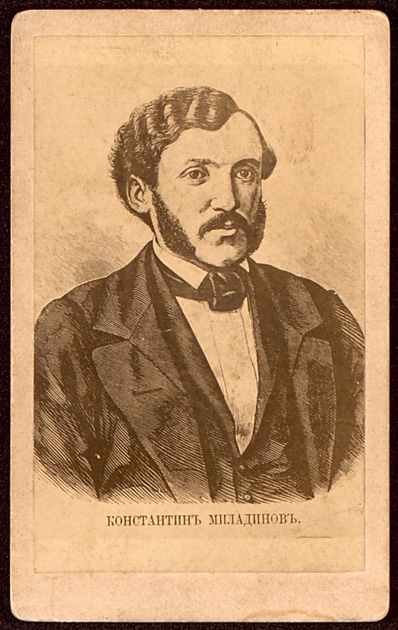
Konstantin Miladinov
Konstantin Hristov Miladinov was born around 1830 in Struga, Macedonia. The son of the master potter Hristo Miladinov, he was the brother of Dimitar and Naum Miladinov. He first studied with Dimitar in Struga, Ohrid and Kilkis, then attended the Greek secondary school in Ioannina from 1844 to 1847. He taught in Tarnovo near Bitola from 1847 to 1849.
He studied Greek philology at the University of Athens between 1849 and 1852, then taught in Magarevo near Bitola before leaving for Odesa in 1856. He continued his education as an external student in Moscow University's Faculty of History and Philology, where he met Bulgarian students including Lyuben Karavelov and Rayko Zhinzifov. A summer visit to the Volga inspired reflections on the past and a profound sense of homeland and national identity.
In 1858, his translation of Ivan Frelov's On the Orthodox Church Brotherhoods that Opposed the Union in South-Western Russia in the Sixteenth, Seventeenth and Eighteenth Centuries was published in Moscow. In it, he expressed concerns about the implications of church union for Bulgarians.
He founded the Bulgarian society Bratski Trud (Fraternal Labour) in 1859 and published poems in its journal. He edited folk songs and other material collected in Macedonia. In spring 1861, he left Russia and published Bulgarian Folk Songs, collected by the Miladinov brothers, in Zagreb. He then headed for Macedonia but learned that Dimitar had been arrested and went to join him in Constantinople. Both died there in 1862; tradition alleged that Phanariots poisoned them.
Known for his broad cultural knowledge and literary work in Russia, Miladinov wrote poetry imbued with homesickness and closeness to ordinary people. His celebrated Longing for the South expresses his deep emotion and attachment to his native land.
Share:


