Voivode Atanas Babata

Voivode Atanas Babata
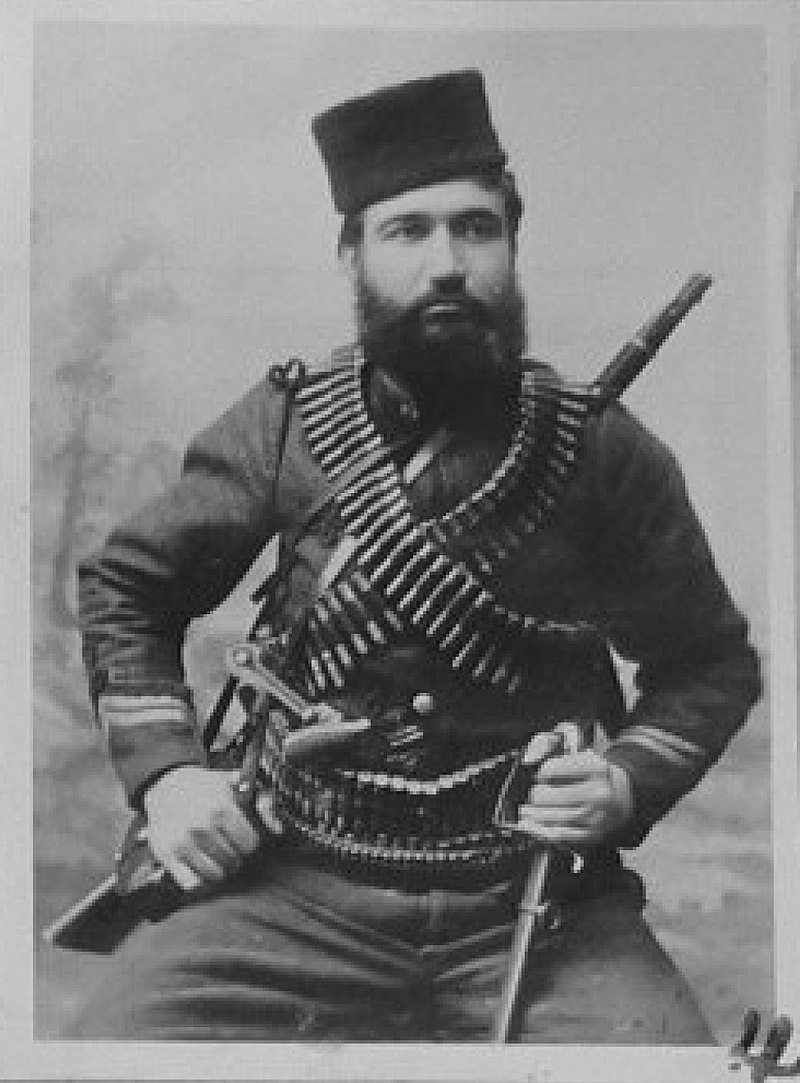
Atanas Babata
Atanas Ivanov Dimitrov, called Babata and Pazardzhikliyata, was a Bulgarian revolutionary and voivode of the Internal Macedonian-Adrianople Revolutionary Organisation, an active participant in the struggle to liberate Macedonia and the Adrianople region.
He was born into a teacher's family in the village of Sinitovo in the Pazardzhik district. Orphaned at an early age, he established himself as a tailor, working as a journeyman in Pazardzhik and later in Sofia. In Sofia he entered the Non-Commissioned Officers' School and in 1897 became a member of the Internal Macedonian-Adrianople Revolutionary Organisation (IMARO). Because of his massive build and large head, he was called Babata.
In 1897 Atanas Babata became a military instructor and was sent to Macedonia by Gotse Delchev, together with Marko Lerinski, Hristo Chernopeev and Mihail Apostolov-Popeto. In 1901 he became deputy voivode in Petar Yurukov's Tikvesh detachment, and later that year became an independent voivode. He participated in the Miss Stone affair with Hristo Chernopeev, Yane Sandanski and others.
During the Ilinden-Preobrazhenie Uprising, Babata's detachment distinguished itself in the Kratovo district, taking part in heavy fighting. After the uprising and a brief stay in Sofia, it returned to the Kratovo district. In 1904 it encountered intensified Serbian propaganda. Following a betrayal on 11 July 1904, the detachments of Atanas Babata, Slaveyko Arsov and Stoyan Donski were surrounded near the village of Gorno Gyugyantsi in the Sveti Nikole district. After a six-hour battle the detachments broke through the cordon, but twenty fighters and the voivode Donski died, while Slaveyko Arsov killed himself. After the battle, Atanas Babata's Kratovo detachment carried out a massacre in Kokoshino, punishing the spies with death.
In December 1904 Atanas Babata's detachment surprised and defeated Jovan Dovezenski's Serbian detachment in Shopsko Rudari. In 1905 it encountered a pursuit force between the villages of Kuklitsa and Pendak, and on Vidim Peak he blew himself up together with his detachment after being besieged by Turkish troops and artillery.
With his exceptional courage, determination and incomparable enthusiasm, Babata became an iconic figure in the history of the Macedonian-Adrianople liberation movement.
Share:


