Tsari Mali Grad

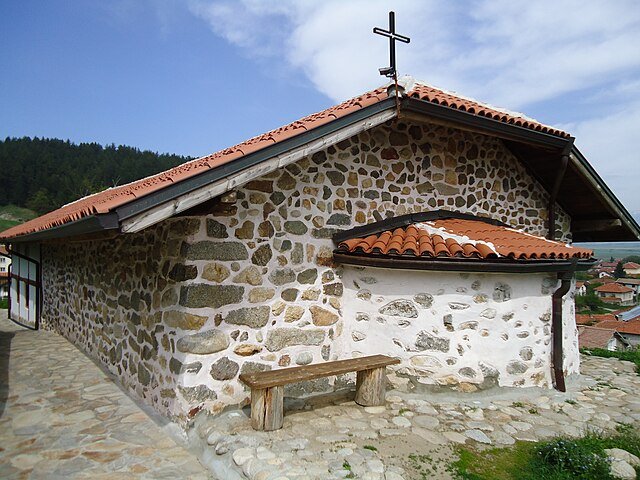
Tsari Mali Grad
Tsari Mali Grad is a Late Antique Roman fortress and fortified settlement in south-western Bulgaria, in Samokov Municipality, Sofia Province. This archaeological site, on St Spas Hill in the Verila Mountains above the village of Belchin, was investigated between 2007 and 2010. The earliest traces of human activity on St Spas Hill date to the Early Iron Age, from the 8th to the 6th century BC. Numerous ritual pits have been found, indicating that the local Thracian population used the place as a sanctuary. After the Romans conquered the region, the hill continued to function as a sacred site. In the 3rd century, it was enclosed by a wall made of wooden stakes, wattle and clay. It was burnt in the middle of the 4th century. Towards the end of the 360s, during the reign of Emperor Valens (364–378), a stone defensive wall was built, enclosing an area of about one hectare. The fortification was reconstructed under Emperor Justinian I the Great (527–565), and under his successor Justin I (565–574), a gate flanked by two rectangular defensive towers was added to the northern wall.
Archaeological investigations show that Tsari Mali Grad ceased to serve a defensive function after 578.
Tsari Mali Grad is an important archaeological site, providing information about religious and settlement practices in the region during different historical periods.
South-western Bulgaria, 4th–6th centuries
Share:


