Troyan Monastery

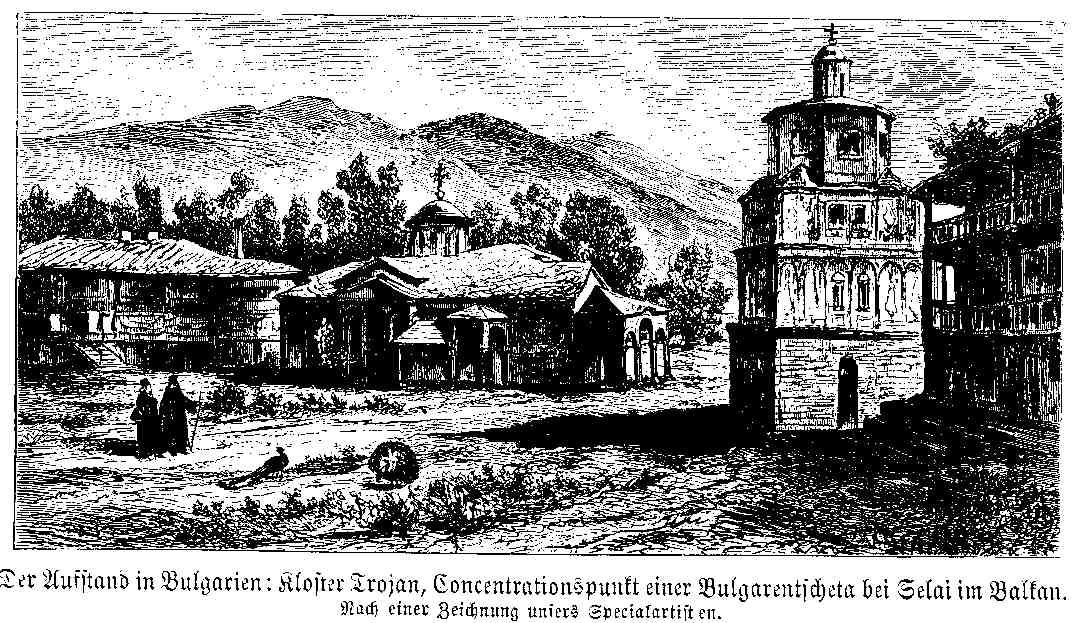
Troyan Monastery
The Troyan Monastery of the Dormition of the Mother of God is a stavropegial monastery of the Bulgarian Orthodox Church, situated in Oreshak on the Cherni Osam River, approximately ten kilometres from Troyan.
The monastery's history begins around 1600 under Abbot Kalistrat. According to tradition, monks from Mount Athos brought its sacred treasure, the wonder-working icon of the Three-Handed Mother of God, a copy of the old miraculous icon in Hilandar Monastery dating from the fourteenth century. The monastery experienced periods of growth and destruction, including an attack by a Turkish band during Abbot Kalistriy's tenure.
According to Konstantin Ognenovich's monastic chronicle, Troyan Monastery is Bulgaria's third-largest monastery and was founded in the early seventeenth century. Its history began with several hermit monks from Mount Athos who arrived carrying the miraculous icon of the Three-Handed Mother of God. In its early years a small wooden Church of the Nativity of the Mother of God, monks' accommodation and a guesthouse were built.
Troyan Monastery possesses a rich history and cultural heritage. According to its chronicle, it sheltered hajduks and revolutionaries. In 1872 Vasil Levski organised a secret revolutionary committee of monks there under Abbot Makariy. During the April Uprising, a command post for the voivodes Panayot Volov, Georgi Ikonomov and Toma Hitrov was established at the monastery.
The cell in which revolutionary matters were discussed has been preserved in its authentic form and is an important part of the monastery's history. Troyan Monastery thus continues to combine its spiritual and historical aspects, offering visitors an opportunity to immerse themselves in its rich history in the heart of Bulgaria.
In the first half of the eighteenth century, under Abbot Hristofor, the monastery expanded again and became economically prosperous. A church school began operating during this period. A water supply was constructed in 1771. From 1780 the master builder Paisiy built a new stone church, followed by residential wings, making the monastery one of the largest of its era.
In 1830 Troyan Monastery was recognised as stavropegial, directly subordinate to the Patriarchate of Constantinople. Construction of a new main church began that year; it was completed and consecrated on 6 August 1835. In 1847–1848 the church was decorated with wall paintings by Zahari Zograf.
The monastery is recognised as an important historic site and occupies a significant place in Bulgaria's cultural heritage. Today it combines its historical value with a spiritual and cultural role.
Lovech Province, near Troyan, Seventeenth–nineteenth century
Share:


