The Madara Rider

The Madara Rider
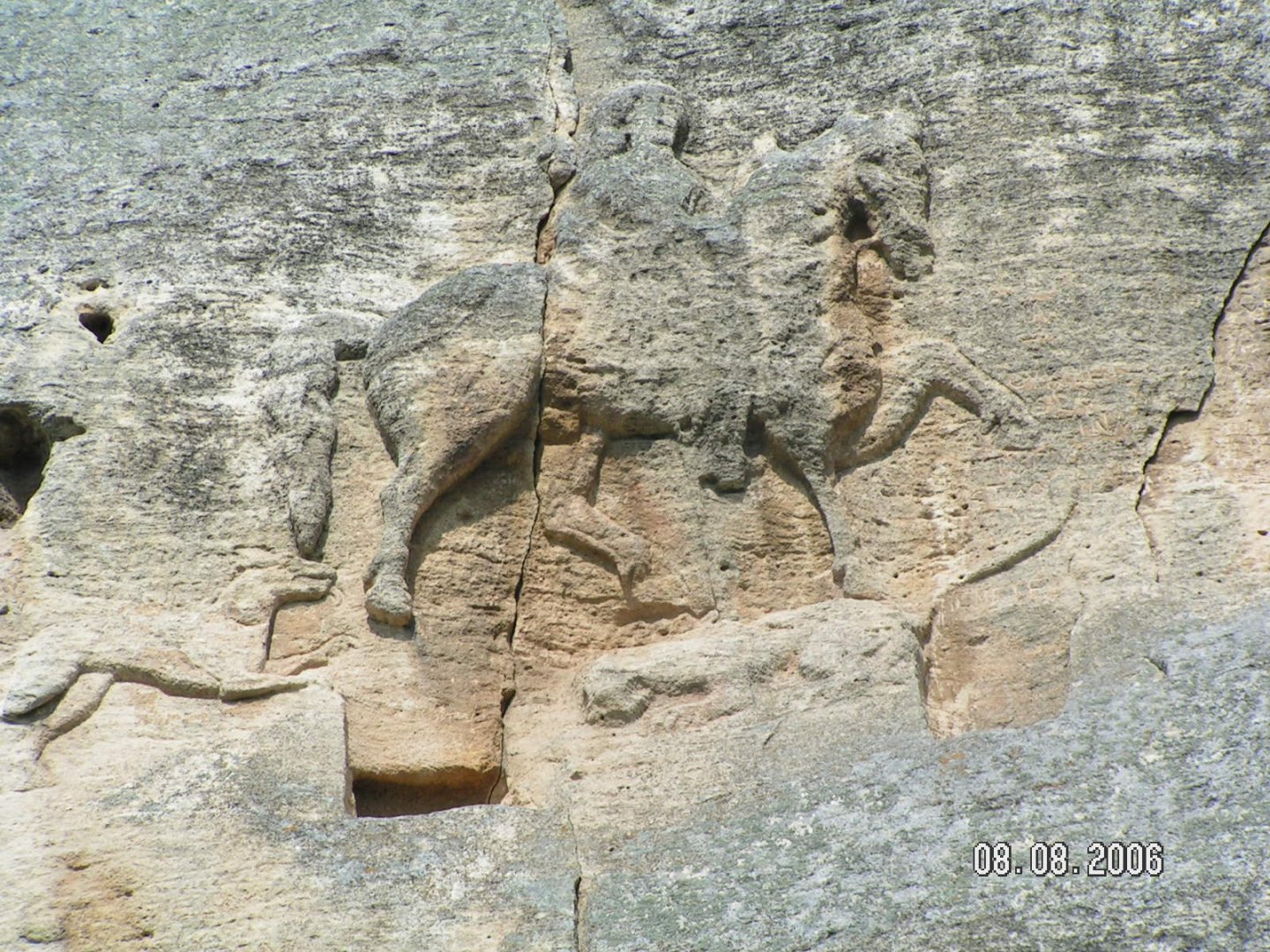
The Madara Rider is a medieval bas-relief carved into a sheer rock face near the present-day village of Madara in north-eastern Bulgaria. It is the only relief of its kind in Europe from the Early Middle Ages and has been designated a UNESCO World Heritage monument.
The Madara Rider is the principal symbol of the Madara National Historical and Archaeological Reserve, which encompasses a series of religious, cultural and military sites. It lies near the village of the same name, 18.2 km from Shumen, although most of the reserve is within Kaspichan Municipality. The archaeological reserves of the medieval Bulgarian capitals Pliska and Preslav are also nearby.
The Madara Rider was brought to the attention of modern scholarship and first described in 1872 by Felix Kanitz. Detailed examination of the relief requires scaffolding, which was erected in 1895, 1905 and 1954. A plaster cast was made in 1905. This historical monument is a rock relief carved in the 8th century AD into a sheer cliff at a height of 23 m. Steep steps to its left lead to the Madara Plateau. The image measures 2.6 m high and 3.1 m wide at its base. It depicts a rider, a lion, a dog, an eagle and inscriptions in Greek.
The relief portrays a triumphant ruler and is now most widely understood as a symbol of the power of the First Bulgarian state. Its details inform its dating and support the theory of its Bulgar origin, associating the image with Khan/Kan Tervel (701–721). The surrounding Greek inscriptions report political and cultural events in relations between Bulgaria and Byzantium from 705 throughout the 8th and 9th centuries, mentioning or alluding to the rulers Tervel, Justinian II, Kormisosh and Omurtag. The Madara relief forms part of a cult complex on the terrace beneath the cliffs, created by Omurtag.
Greek inscriptions carved around the rider’s figure contain important information about Bulgarian history. Professor Veselin Beshevliev suggested that an inscription might “be connected with the name Asparuh”. Of particular interest and importance is Omurtag’s inscription, discovered at the pagan sanctuary below the Madara Rider: it alone preserves a direct mention of Tangra, the supreme god of the Bulgars.
Near Shumen, Bulgaria, 8th century
Share:


