The capital of Preslav

The capital of Preslav
Preslav was the second capital of the First Bulgarian Empire. It was initially established as a residence of secondary importance, with a group of military camps and fortified palaces known as auls. The development of Preslav as the Bulgarian state’s capital began under Prince Boris I and was completed in the 10th century by Tsar Simeon and Tsar Peter, under whom it reached its greatest prosperity.
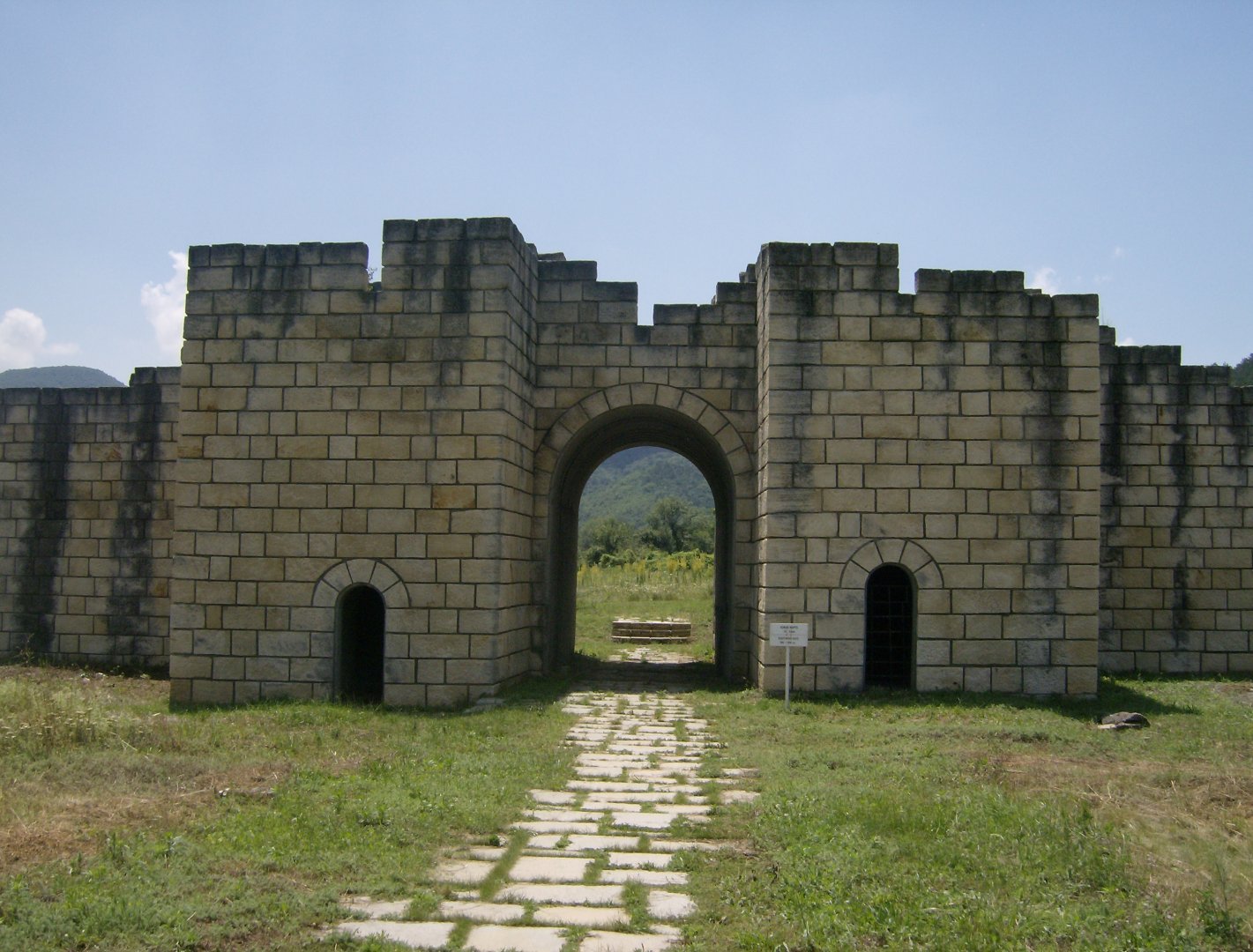
Preslav’s defences consisted of massive stone walls. It was a densely built town with distinct zones and quarters. Access to the interior was protected by four gates aligned with the cardinal directions. A second defensive circuit protected the most important buildings in Preslav’s Inner Town. These included the ruler’s residence, the throne building, the royal church and service buildings grouped around a courtyard with a garden, pavements and porticoes. The palace, comprising a throne hall, private apartments and ancillary buildings, dominated the surrounding structures. To its south stood the Palace Basilica, known as the Round or Golden Church, connected to the residence of the head of the Church.
One of the distinguishing features of construction in Preslav was its many churches and monasteries, intended to demonstrate the Bulgarian state’s break with pagan traditions.
An Outer Town also developed beyond the fortified part of the capital. It contained areas devoted to specialised activities, estates and urban monasteries, with a network of streets and squares. Among the monastic complexes was the monastery bearing the name of Mostich, a senior dignitary under Tsars Simeon and Peter. Another, at Patleyna, was associated with Prince Boris’s time as a monk. The monasteries within and outside the town were centres of spiritual and literary life in the 9th and 10th centuries. The Preslav Literary School added to the Bulgarian state’s rich culture. Writers of its first literary circle included Chernorizets Hrabar, John the Exarch and Constantine of Preslav.
Besides flourishing as a cultural and religious capital, Preslav possessed important craft centres where different branches of art developed. These workshops produced architectural details such as cornices and capitals, stone sculpture, Preslav painted ceramics, and interior and exterior architectural decoration intended for churches.
The capital of Preslav was captured by the Byzantine emperor John Tzimiskes (969–976) and his successor Basil II the Bulgar Slayer (976–1025). During Byzantine rule over the Bulgarian lands, Preslav remained a strongly fortified town with a large garrison. In 1186, the brothers Asen and Peter attempted to liberate Veliki Preslav and proclaim Bulgaria’s independence from this centre, but a large Byzantine military garrison was stationed there. After Tarnovo was declared capital of the Second Bulgarian Empire, Veliki Preslav remained primarily a centre of the clergy.
Today, Preslav’s ruins are conserved within a National Historical and Archaeological Reserve.
North-eastern Bulgaria, 9th century
Share:


