The capital of Pliska

The capital of Pliska
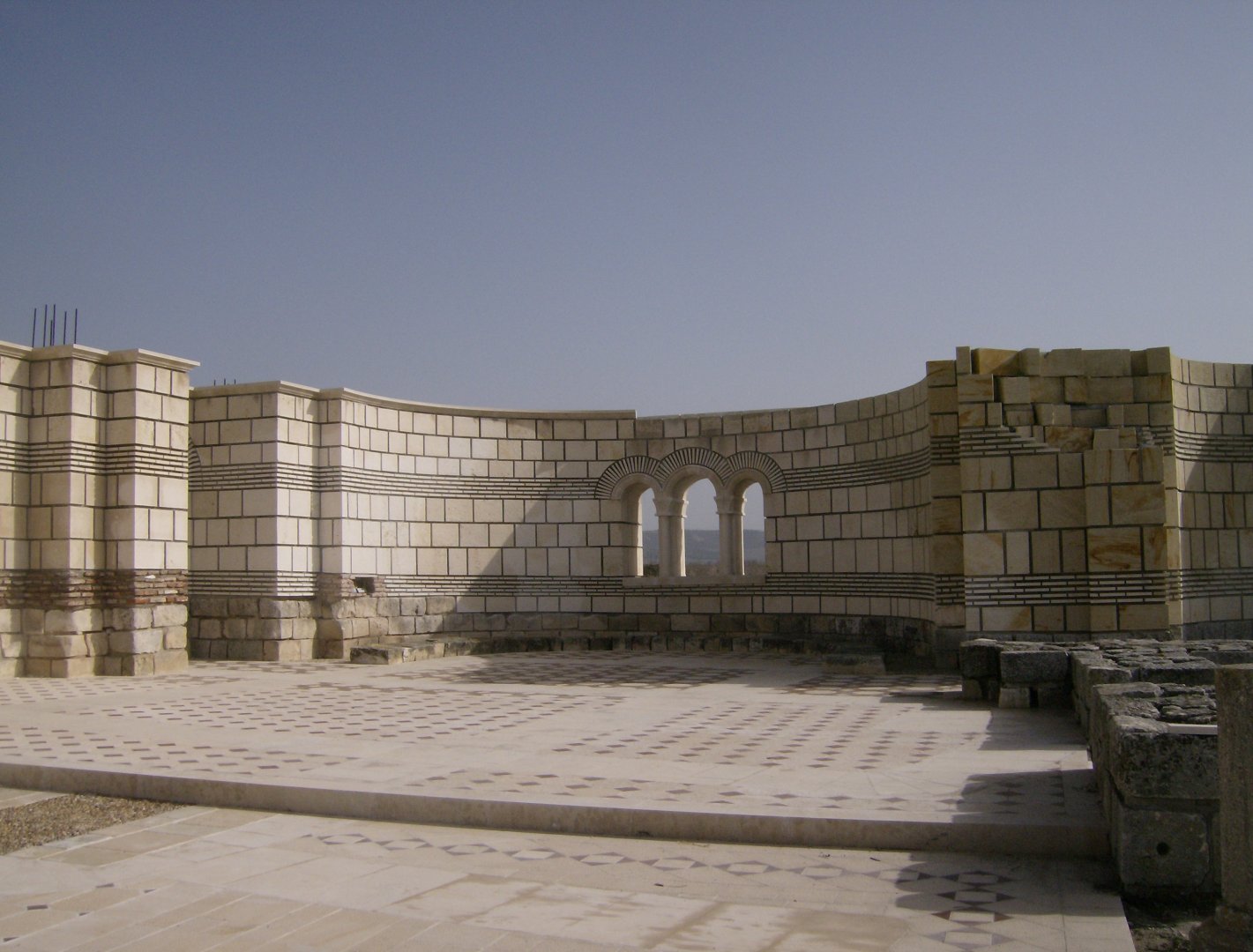
The remains of the former Bulgarian capital have been uncovered on flat terrain near the village of Aboba in the Shumen region. The Bulgar state chose this location as its capital as early as the end of the 7th century because of its central position. A truly fortified centre of statehood, however, emerged only towards the end of the 8th century, when earthwork camps were established. During its time as capital, Pliska was defended by three concentric lines of fortifications. The first was a large earthwork consisting of a ditch and earthen rampart. The second defensive line was also an earthwork, protecting the inner stone fortress. The innermost defences consisted of a stone wall with brick masonry. The wall was reinforced with 16 defensive towers: the corner towers were cylindrical, while along the wall there were three gate towers as well as towers with a pointed edge and a pentagonal plan. The towers stood far apart. A wooden fortress, known as Krum’s Palace, was initially built within the defended area, but it burnt down and was replaced by a stone building. The buildings within Pliska fall into two periods: before and after the fire of 811. Before the fire, several structures were built from perishable material, namely wood. These included the Large Pool (water reservoir), a building with a domestic-type bath, a circular pool and a bath with a hypocaust, Krum’s Palace, a large “round” wooden platform and a wooden building. After the fire of 811, the Throne Palace, a large pagan temple, a small pagan temple, a small palace, a residential building above the reservoir, a bath and “Boyar’s Residence”, and a bath with a hypocaust were constructed. Wooden buildings were erected in the south-eastern and north-western parts of the fortification. Outside Pliska’s fortified residential area, in the Outer Town, several settlements, a production centre with workshops for working iron, non-ferrous metals, glass and bone, and burial grounds have been recorded.
Pliska’s appearance did not change significantly after the adoption of Christianity. Among the most important monuments of its Christian period were the Great Basilica and the associated complexes.
Towards the end of the 11th century, Pliska became depopulated and ceased to exist as an important medieval centre.
Today, Pliska is a National Historical and Archaeological Reserve. The excavated remains have been conserved and arranged as an open-air museum.
North-eastern Bulgaria, 7th century
Share:


