Sokolski Monastery

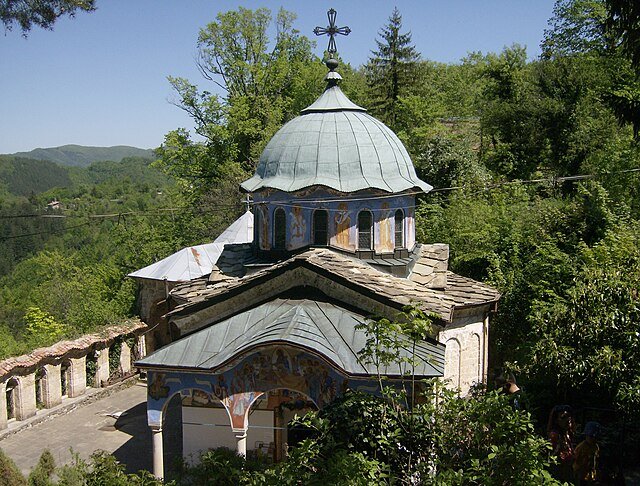
Sokolski Monastery
The Sokolski Monastery of the Dormition of the Mother of God, also known as the Gabrovo-Sokolski or Gabrovo Monastery, is an active convent of the Bulgarian Orthodox Church in northern Bulgaria, near Gabrovo. It was founded in early 1833 by Yosif Sokolski, who later played an important role in the struggle for ecclesiastical autonomy as a Uniate archbishop.
The monastery was established by Archimandrite Yosif, who returned from Troyan Monastery accompanied by Hieromonk Agapiy. Many of its buildings, including the church and first residential wing, were built by master builder Konstantin of Peshtera. The courtyard contains the Sokolski Fountain, attributed to master builder Nikola Fichev.
Officially opened on 15 August 1834 by Metropolitan Hilarion of Tarnovo, the monastery developed educational and literary activities under Yosif Sokolski's leadership. A school opened there in 1836, with Neofit Bozveli among its teachers. In the late nineteenth century the monastery underwent renovation and decoration, including wall paintings, an iconostasis and a fountain; an icon for the church was painted by the Gabrovo artist Hristo Tsokev.
In 1876, during the April Uprising, the monastery sheltered the detachment of the voivode Tsanko Dyustabanov, who played a decisive role in the uprising. After the defeat of the voivode and his men, eight of them were hanged on the rocks near the monastery. It also served as a military hospital during the Russo-Turkish War of 1877–1878. On 31 July 1856, Captain Dyado Nikola's detachment established itself here, intending to make the monastery the centre of the uprising he was preparing. The detachment's flag was blessed here as well. Vasil Levski also found refuge at the monastery.
Sokolski Monastery has a rich history and is an important Bulgarian historic site associated with significant events of the National Revival and the national liberation struggle.
Gabrovo Province, 1833
Share:


