Mechoka Rock Sanctuary

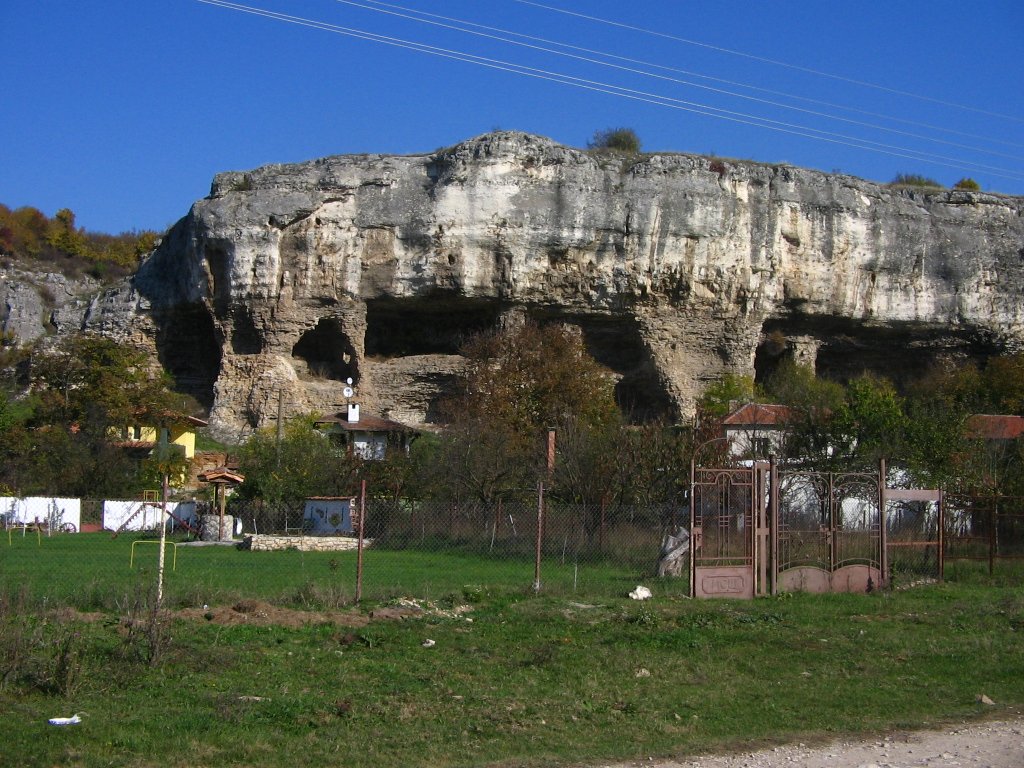
Mechoka Rock Sanctuary
The Mechoka Rock Sanctuary and the adjoining prehistoric settlement near the village of Gortalovo in Pleven Province are among the oldest inhabited sites in Bulgaria and the Balkans.
This unique site lies around the natural rock column known as Mechoka, or the Bear, which was 11 metres high and covered an area of 6 square metres, attached to the canyon rock southwest of the village. The column was destroyed by treasure hunters in the 1970s. In the second half of that decade, archaeologists discovered material from a prehistoric settlement on the right bank of the River Chernyalka that had existed from the Neolithic to the Bronze Age. Today, a thick layer of fallen rock fragments covers the settlement. According to Professor Dimitrina Mitova-Dzhonova, life in the settlement was connected with the sanctuary and the rock paintings on a block of the rock massif, depicting human and animal figures, geometric ornaments and alphabetic signs. Holes, often arranged in patterns, were cut in this context.
The history of discovery begins with Vasil Mikov's first scholarly publications in 1921, in which he described and publicised the graffiti and rock paintings. Mikov noted that the so-called Mechoka Rock was badly damaged and no longer retained the shape that had given it its name. Mara Tsoncheva subsequently published paintings from the sanctuary, executed in white and dark colours and depicting deer, goats, a dog and other subjects. In her view, the artistic style, the way the paint was applied and the subjects indicate a prehistoric origin. There are reports that similar rock paintings still survive in small caves and on the surfaces of concealed rocks in the river canyon.
As regards dating, Vasil Mikov assigned them to the Neolithic and Bronze Age, while Ivan Velkov associated the carved holes with so-called Schalensteine—cup-like ritual hollows characteristic of Central Europe—and dated them to the same period. Velkov assigned the human figures to the Early Middle Ages and linked them to Christianity, arguing that they resembled examples found in the Pyrenees and the Caucasus. Professor Ana Raduncheva firmly dates the rock paintings, graffiti and carvings to the Neolithic and Bronze Age.
The historical context of this region includes other archaeological sites of exceptional interest, such as the split stone and the Momina Dupka labyrinth, also associated with Late Antiquity and the Middle Ages. An old Roman road linking Nicopolis ad Istrum with Melta is believed to have passed through the village.
Pleven Province, near Gortalovo village, Bronze Age
Share:


