Khan Omurtag's Aul

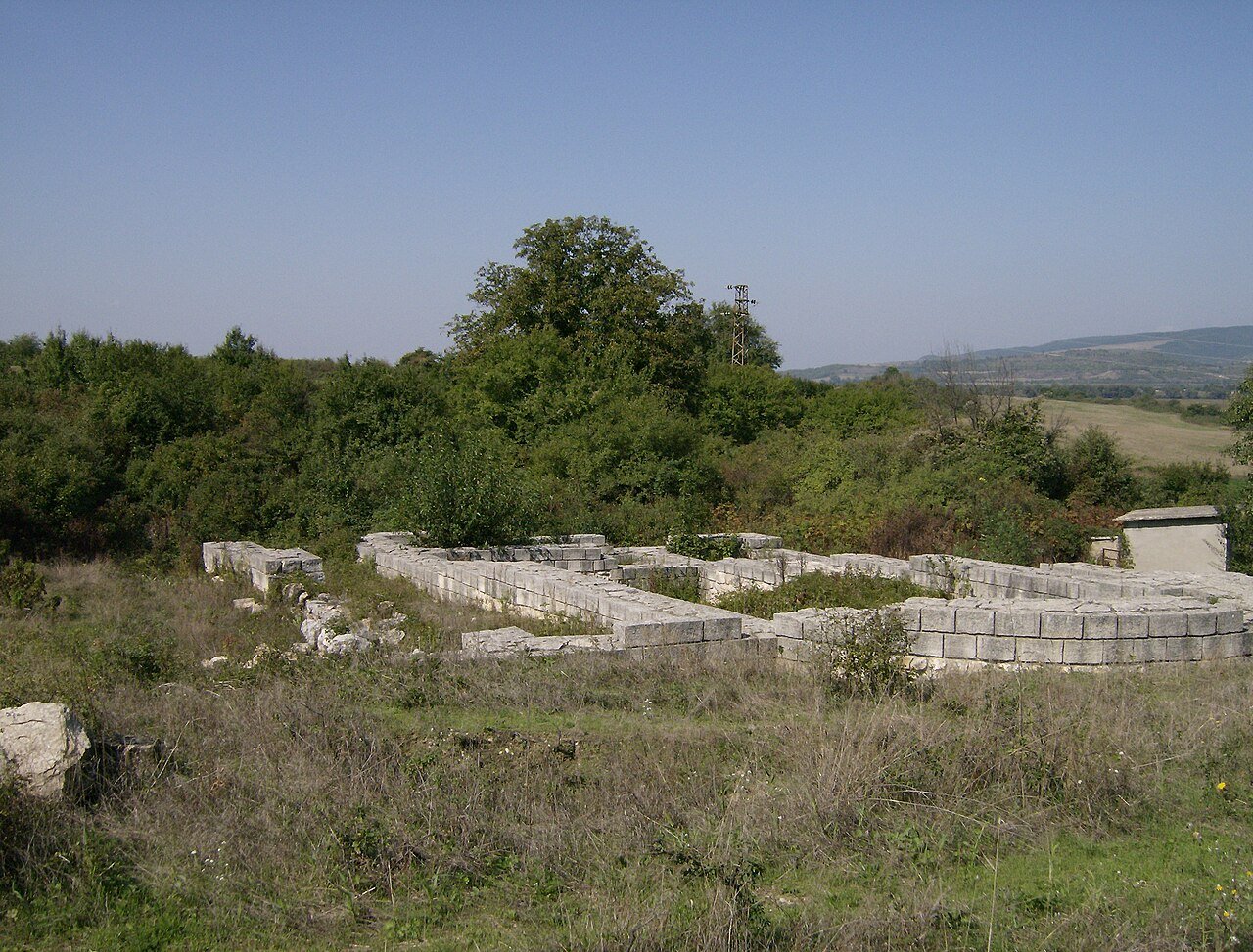
Khan Omurtag's Aul
Khan Omurtag's Aul, also known as the Omurtag Aul, is a military fortification or fortified palace built in 822 during Khan Omurtag's reign. Part of the Pliska–Preslav culture, it is associated with the khan's own building activities. It is thought that the aul may be identified with the palace mentioned in the Chatalar Inscription. Archaeological investigation has also revealed an earlier cultural layer dating from the fourth–fifth century, attesting to a Gothic presence in the area.
The aul lies in the Hisar Kale locality, approximately two kilometres south of the village of Han Krum and the Kamchiya River, and around ten kilometres from Shumen and Veliki Preslav. Although access is difficult and the site has not been developed for visitors, it has been archaeologically investigated since 1957, with work continuing until the early 1980s. Investigations resumed in 2002 under research fellow Todor Balabanov of the Shumen branch of the Archaeological Institute of the Bulgarian Academy of Sciences.
Five churches from the Gothic period have been uncovered in the area, indicating a Gothic Arian episcopal centre. A large episcopal church was found beneath a mound, with another Gothic church nearby containing Early Christian wall paintings regarded as Bulgaria's earliest. This church complex is also associated with the Gothic bishop Ulfilas, who created the ancient Germanic alphabet and translated the Bible into Gothic.
During the Bulgarian period, in 822, Khan Omurtag built the aul on the model of Pliska, the capital of the First Bulgarian Empire. Archaeologists discovered an area of around half a decare within it, thought to have been a pagan ritual installation where sacrifices were performed. Finds include a stone block with a channel to drain blood from sacrificial animals, along with traces of sacrificed goats and hares. The aul's role in the military system of the First Bulgarian Empire remains unclear.
Shumen Province, Fifth–ninth century
Share:


