Demir Baba Tekke

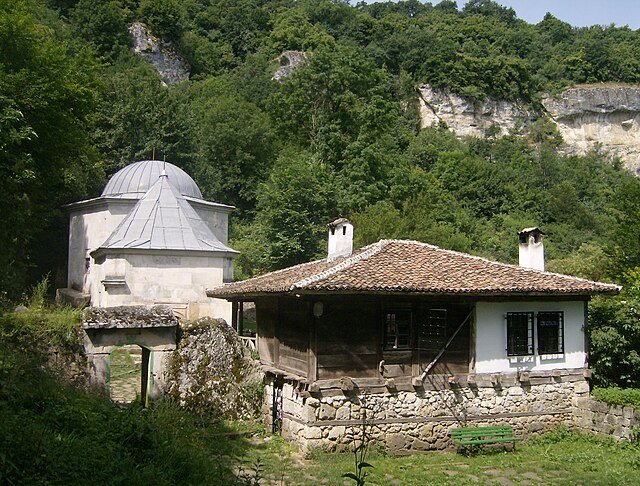
Demir Baba Tekke
Demir Baba Tekke is an Alevi sanctuary with a türbe, or mausoleum, near Sveshtari in Razgrad Province, northeastern Bulgaria. It lies in a bend of the Krapinets River canyon beside a powerful karst spring and forms part of the Sboryanovo Historical and Archaeological Reserve. The tekke was among Bulgaria's first national cultural monuments, officially designated in 1927. According to the Ottoman apocryphal book "Vilayetname", the türbe was built between 1612 and 1617 and is thought to contain the grave of the sixteenth-century Alevi saint Hasan Demir Baba Pehlivan. The mausoleum is heptagonal, built of local sandstone, with a hemispherical dome reaching eleven metres high. The saint's grave lies in the centre of the chamber, with its head oriented southwest. Excavations in the surrounding area in 1983–1991 revealed an ancient Thracian sanctuary beneath the türbe, associated with the Thracian urban centre of the Hellenistic period. Demir Baba Tekke is an important sanctuary used by Alevis, Christians and Muslims. Rituals such as washing in the sacred spring, tying scraps of clothing to trees and offering sacrificial feasts continue today. Legends portray Demir Baba as a dragon-fighter, healer and vanquisher of the lamia. The place has been sacred to different tribes and peoples for more than 2,000 years. In 1970 it was declared a cultural monument, and restoration work in recent decades has sought to preserve its architectural and historical heritage.
Razgrad Province, near Sveshtari, 1612–1617
Share:


