Belintash

Belintash
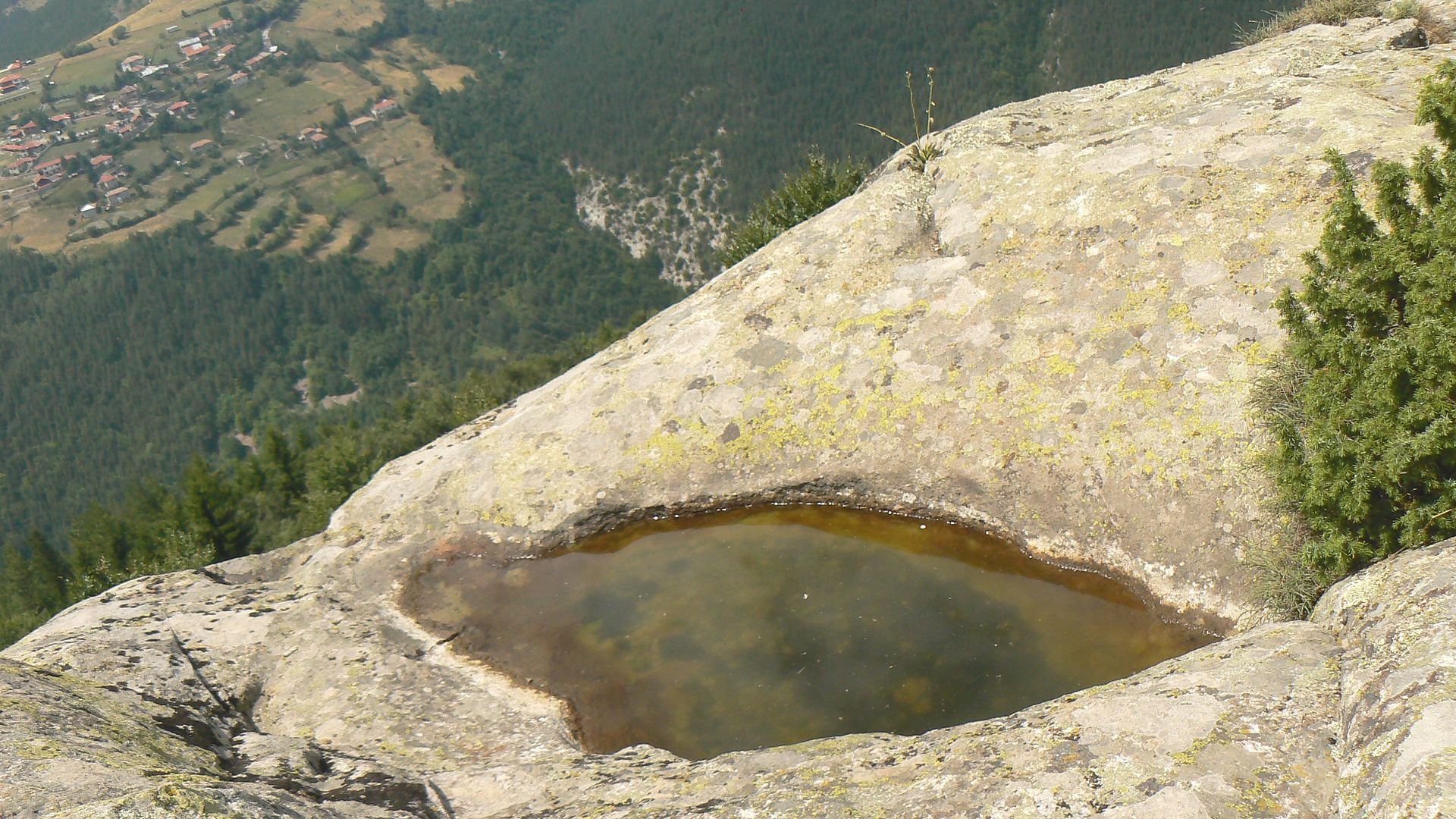
Belintash is a rock formation in the Rhodope Mountains shaped like a small plateau and bearing traces of human activity. It is thought to be a religious site used for rituals during the Chalcolithic. Circular holes, channels, niches and steps are cut into its upper platform, forming what some believe to be a map of the starry sky. Hypotheses suggest that the sanctuary was dedicated to the god Sabazios during the period when Thracians inhabited the region.
The rock sanctuary lies 30 km southeast of Asenovgrad and is Bulgaria's second-largest after Perperek. It covers approximately five decares, with a rock platform around 300 m long at an elevation of 1,225 m. The location is in the Rhodope Mountains and is known for magnetic anomalies.
Professor Ana Raduncheva, a renowned Bulgarian prehistorian, links the Chalcolithic temple complex near Dolnoslav with Belintash, regarding both as integral parts of the high-mountain system of rock sanctuaries.
Theories about the origin of "Belintash" include interpreting the place name as "White Stone", thought to derive from "beli", meaning white, and "tash", meaning stone. According to local historian Nikola Boev, the name can also be translated as "Stone of War", connecting it with the sacred war over the principal sanctuary of Sabazios/Dionysus in the Rhodope Mountains.
Belintash has been the subject of numerous archaeological investigations. Archaeoastronomical research indicates a connection between the anomalies and the arrangement of structures in the sanctuary. Finds include Chalcolithic clay figurines and pottery, supporting the supposition that the sanctuary was actively used in that period.
A local legend tells of a Bulgarian maiden who jumped from the rocks to save her honour. This legendary act is associated with the name "Bela Snaga", or "White Body". Despite the various interpretations, the site remains an important archaeological monument and testimony to the region's ancient history.
Plovdiv Province, Rhodope Mountains, Fifth century BC
Share:


