Bachkovo Monastery

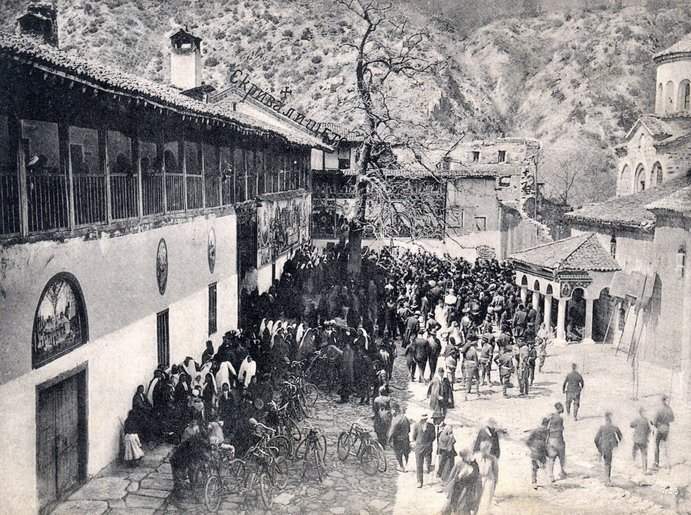
Bachkovo Monastery
The Bachkovo Monastery of the Dormition of the Mother of God is Bulgaria's second-largest monastery after Rila. It lies near Bachkovo in Asenovgrad Municipality, Plovdiv Province. The monastery is stavropegial, which means that it is autonomous and subordinate only to its own administration, rather than to the Church. Celebrating its feast day on 15 August, Bachkovo Monastery stands in the picturesque valley of the Chepelarska River, approximately ten kilometres south of Asenovgrad.
The monastery was founded in 1083 by Gregory Pakourianos and Abasios, the brother of the Grand Domestic of the western armies of the Byzantine emperor Alexios I Komnenos. The monastic rule, drawn up on the founder's orders, survives in Greek and Georgian copies. In the eleventh century a literary school known as the Petritsoni School developed here, maintaining links between medieval Georgia and Byzantium. In 1344 the Stanimaka region was ceded to Ivan Alexander by the Byzantine empress Anna of Savoy.
After Tarnovo's fall in 1393, Bachkovo Monastery continued to play an important role. In 1628 Patriarch Cyril I Lucaris confirmed its stavropegial rights. In 1801 Abbot Makariy was confirmed in office by the Metropolitan of Plovdiv, and in 1894 the monastery came under the Bulgarian Exarchate.
From 1941 to 1947 the Plovdiv Theological Seminary was evacuated to the monastery. In 1947 a fire destroyed the seminary's rich library. The Bulgarian Exarch Stefan and Patriarch Kiril are buried at the monastery. The icon of the Most Holy Mother of God is Bachkovo Monastery's greatest sacred treasure. Kept in its main church, it is an object of veneration and pilgrimage for believers. The icon depicts the Mother of God and the Child, but only their faces are visible. Everything else is covered, as a mark of honour, by two silver revetments.
The icon has two silver revetments. The older bears an inscription stating that it was donated in 1311 by the Georgians Athanasius and Okropir, or Chrysostom. The newer dates from 1819.
The earliest written account of the icon is by the French traveller Paul Lucas, who visited the monastery in 1706. He described it and mentioned the monks' claim that it had been painted by St Luke. Stories associated with the icon say that it came to the monastery from Georgia.
The monastery also preserves a tradition that the icon "flew" from a Georgian monastery and "landed" in the Kluviyata locality near Bachkovo. At its "landing", a blazing, unquenchable fire was seen. Shepherds, a brother and sister, gazed at it for three consecutive nights and brought it to the monastery, after which it "escaped" and was brought back again. According to tradition, the Mother of God appeared in a monk's dream and told him that she would remain if given a special place on the right near the church entrance. Every year on Easter Monday the icon is carried in a religious procession to Kluviyata, where a prayer service is held. This custom continues today.
The icon of the Most Holy Mother of God at Bachkovo Monastery thus became both a religious symbol and an object of admiration and veneration, preserving the monastery's rich history and traditions.
Plovdiv Province, near Bachkovo, Eleventh–twentieth century
Share:


