The Kosovo Operation

The Kosovo Operation
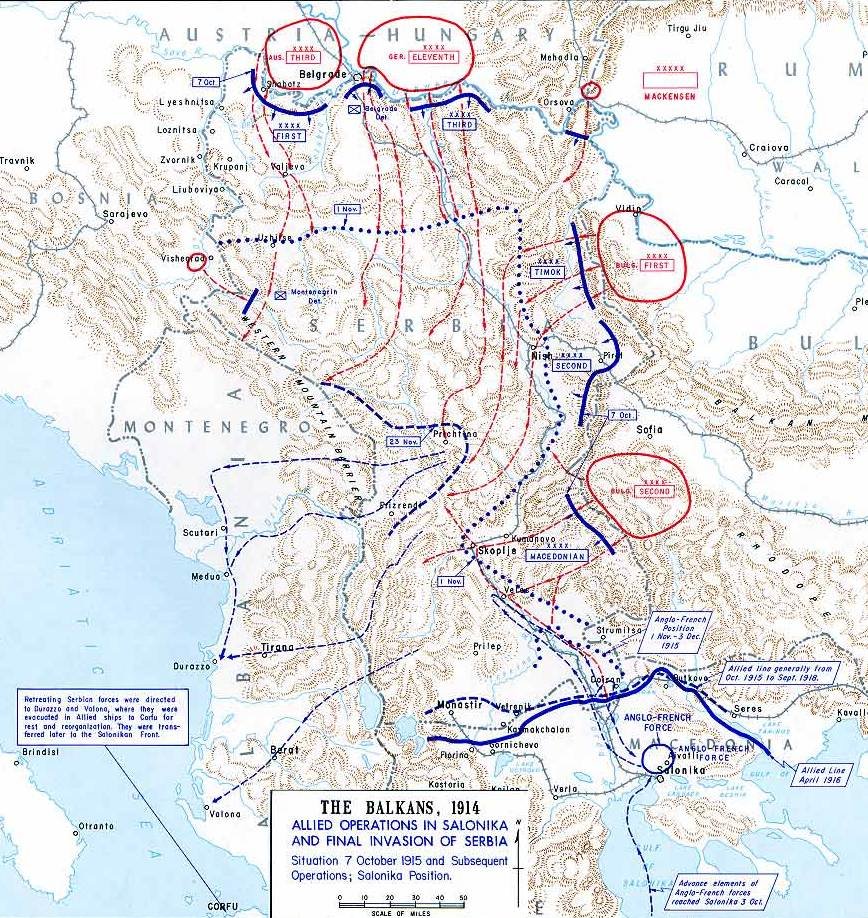
On 1 November, Bulgarian aerial reconnaissance detected the Serbian withdrawal, and the First Army immediately crossed the South Morava. It operated alongside the Second Army's Northern Operational Group and part of the German Eleventh Army, creating the conditions to encircle the enemy in Kosovo Polje. The First Army delivered the main blow along the Niš–Pristina axis. Within two days, Bulgarian units captured Prokuplje after brief resistance and began pursuit.
Meanwhile, the Third Division, supported by other units, advanced from the south against the Gjilan–Kačanik line, but fierce resistance halted it.
The Bulgarian advance continued more slowly on both fronts over the following days. On 9 November, Bulgarian units entered Kosovo from both directions. The Serbian army attempted a counterattack towards Vranje and Kumanovo to join the Anglo-French forces, but was repelled. The First Army's Sixth and Ninth Infantry Divisions captured Pristina with little resistance on 24 November. The whole First Army advanced, supported by the northern units of the German Eleventh Army.
The Kosovo Operation ended on 4 December with the capture of Debar and Gjakova. The Serbs lost 36,000 soldiers, 199 guns, 150 motor vehicles and large quantities of horses and other military equipment.
The operation completed the conquest of southern Serbia and Macedonia, with troops advancing to a depth of 170 kilometres.
The battle ended in a decisive Bulgarian victory and Serbian defeat.
Share:


