Serbo-Bulgarian War

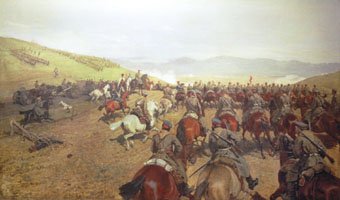
Serbo-Bulgarian War
The Serbo-Bulgarian War began on 14 November 1885 (2 November Old Style). It was a pivotal event in Bulgarian history, helping secure international recognition of the Unification of the Principality of Bulgaria and Eastern Rumelia.
The conflict grew out of the Unification in 1885. Serbia saw it as a threat to its interests in the Balkans, while Austro-Hungarian support for Serbian demands heightened tensions.
Using an Austro-Hungarian loan to expand its armaments, Serbia mobilised, campaigned against the Unification and demanded compensation from Bulgaria. Despite intense diplomatic pressure from all sides, Bulgaria refused its neighbours' demands.
The conflicting interests and fears of the European Great Powers prevented active international intervention. All the major states adopted a neutral position, although some expressed a preference for Serbia.
The Battle of Slivnitsa on 17 November 1885 was the war's decisive moment. Bulgarian troops under Captain Dimitar Genov defeated the Serbian forces, a victory of immense importance for the region's future.
Bulgaria's victory compelled the international community to recognise the Unification. It ended the conflict with Serbia and opened a new chapter in Bulgarian history.
On 27 September, Serbian units crossed the frontier near Tran but were repelled by the Bulgarian army. A second border incident followed the next month. Bulgaria protested to the Great Powers without success. Serbian troops concentrated along the frontier in late October. On 2 November, Serbia declared war, citing alleged Bulgarian attacks in border areas. That day, Prince Alexander of Battenberg issued a manifesto calling on the Bulgarian people to defend their homeland and freedom.
Bulgaria sent a note to all the Great Powers asking them to intervene as peacemakers but received no reply. Only the Ottoman Empire, as suzerain, responded to the request for help, and then on condition that Bulgaria renounce the Unification with Eastern Rumelia.
Both sides developed operational plans. Serbia intended to advance along the Pirot–Tsaribrod road, defeat Bulgarian forces in the border regions and capture Vidin and Sofia. It possessed substantial forces and a well-organised supply system.
Despite limited finances, the Bulgarian army prepared for war. It comprised trained soldiers, reserve units, militia and volunteers, totalling more than 100,000 men. Though short of experienced officers, equipment and resources, Bulgaria prepared to resist the Serbian attack.
Bulgaria had a plan for war against the Ottoman Empire but was unprepared for conflict with Serbia. Its troops were divided into Eastern and Western Corps, with the Western Corps responsible for the Serbian frontier. Despite its numerical weakness, Bulgaria prepared to resist and hoped for Ottoman support.
After the decisive Bulgarian victory at Pirot, the Serbian army faced complete defeat. The Bulgarian army was preparing to attack Niš when Count Khevenhüller, the Austro-Hungarian minister in Belgrade, arrived at Bulgarian headquarters in Pirot on 28 November (16 November Old Style). He urged Prince Alexander I of Battenberg to halt the advance, threatening Austro-Hungarian intervention and possible Russian involvement. The Bulgarian ruler was forced to agree, and the existing front became the demarcation line.
Armistice negotiations followed and concluded on 21 December (9 December Old Style). The peace treaty was signed in Bucharest on 3 March 1886 (19 February Old Style).
Victory strengthened Bulgaria's international position and helped secure recognition of the Unification.
Serbia's defeat intensified public discontent with King Milan. In 1889, after three years of political instability, he abdicated in favour of his son.
Share:


