Second Balkan War

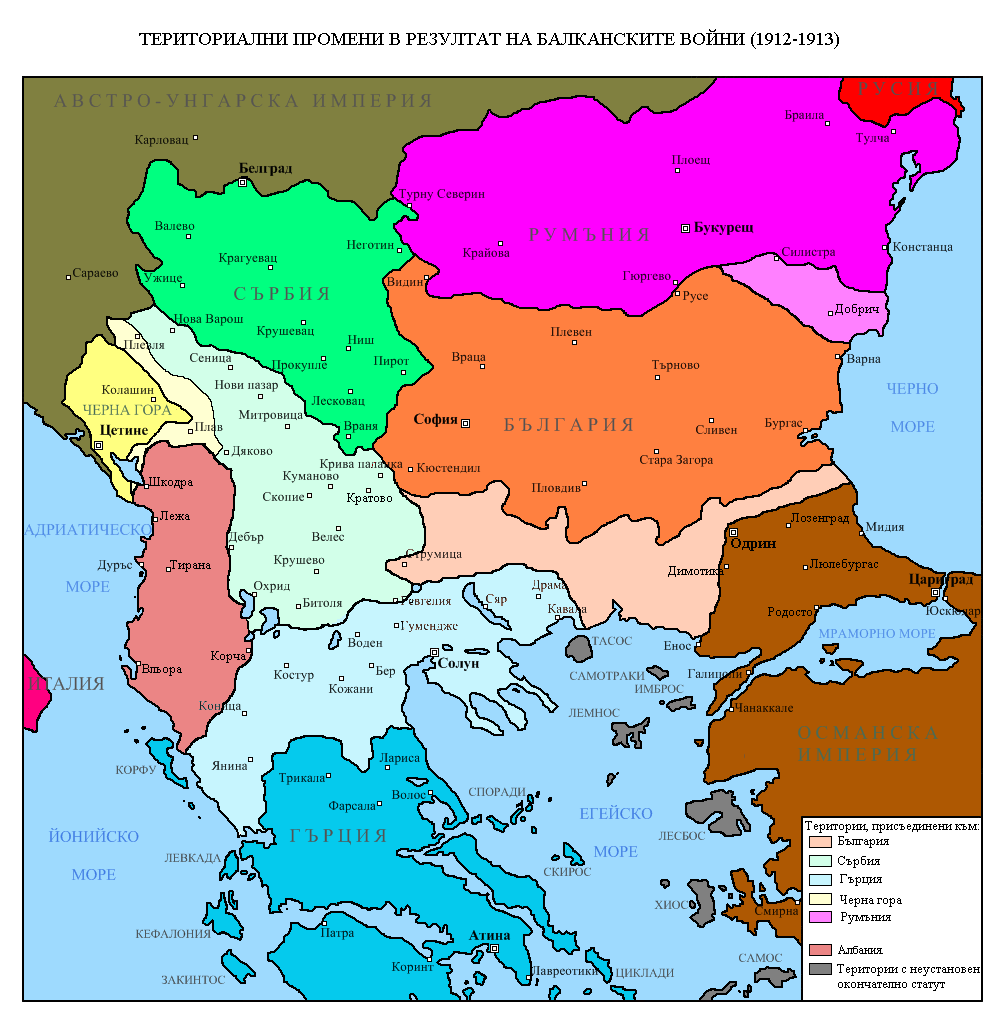
Second Balkan War
The Inter-Allied War, or Second Balkan War, broke out in summer 1913 between Bulgaria on one side and Serbia, Greece, Montenegro, Romania and the Ottoman Empire on the other.
The war arose from a dispute among members of the Balkan League over the division of territories taken from the Ottomans in the First Balkan War. Fighting began in Macedonia after the unsuccessful attempt by the Second and Fourth Bulgarian Armies on the night of 16–17 June to drive Serbian and Greek troops from the disputed areas.
After fierce fighting at Kočani and Kilkis in the opening days, the Bulgarians were forced eastwards along the Bregalnica and northwards along the Struma. Romania joined Bulgaria's opponents on 28 June, and both Romania and the Ottoman Empire took an active part in the fighting.
The dispute intensified as Bulgaria sought to retain most of Macedonia, while Serbia and Greece sought larger territorial gains. Under the Treaty of Bucharest of 28 July, Bulgaria had to surrender much of Macedonia to its former allies and Southern Dobrudja to Romania.
The peace treaties failed to resolve the Balkan states' differences, leading to renewed warfare during the First World War.
On 17 June, Bulgarian troops advanced in Macedonia with partial success. The Second Army cleared Greek forces from the left bank near the Struma's mouth and cut communications between the Greek and Serbian armies by taking Gevgelija. However, the Bulgarian garrison in Thessaloniki remained isolated and was captured by a Greek division on 18 June. The Fourth Bulgarian Army crossed the Bregalnica and Zletovska rivers and secured the approaches to Sultan Tepe in the Osogovo Mountains. The Fifth Army's advance north of Osogovo was delayed, while the First and Third Armies remained inactive for political reasons: Danev's government held back the planned offensive into Serbia while seeking a peaceful settlement.
Serbian and Greek counterattacks after 18 June inflicted heavy losses on the Fourth Bulgarian Army's right flank. Although the Bulgarians repelled Greek attacks at Krivolak on 21 June, Greek superiority in men and artillery forced them to withdraw. Bulgarian positions at Lachanas and Kilkis were breached on 21 June, and the Bulgarian right wing was defeated at Doiran on 23 June. Encouraged by their success, Greek forces advanced towards Belasitsa and the Struma.
Meanwhile, the First and Third Bulgarian Armies entered the fighting on 22 June, with government approval following the Serbian crossing of Bulgaria's former border near Kyustendil. The First Cavalry Division began crossing the Balkan Mountains through the Kadaboaz and Sveti Nikola passes to seize Pirot's fortified camp. Other Bulgarian troops attacked the Bukova Glava ridge to cut the railway between Old Serbia and Macedonia. On 24 June, units of the Fifth Bulgarian Army defeated Serbia's Danube Division and threatened to descend towards Skopje along the Pčinja valley.
Romanian intervention changed the course of the war. On 28 June, the Romanian army crossed the Dobrudja frontier, threatening the Bulgarian navy and precipitating the resignation of Danev's government. Bulgaria conceded Romania's demands for Southern Dobrudja, but the Romanian advance towards Sofia continued. Bulgarian troops therefore faced the Greek and Serbian armies on one side and the Romanian army on the other, forcing them to retreat towards Sofia and Pazardzhik.
Share:


