Paris Peace Treaty

Paris Peace Treaty
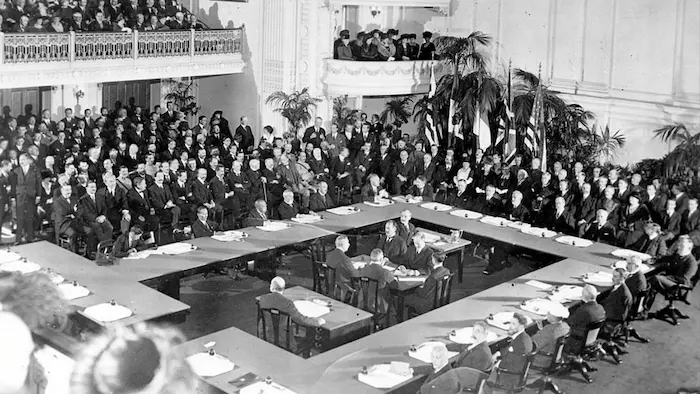
After the Second World War ended, its territorial, political and economic consequences had to be settled. One of the most important documents used to do so was the Paris Peace Treaty, signed on 10 February 1947 at the Quai d’Orsay in France. Representatives of the defeated Axis states—Italy, Romania, Hungary, Finland and the Kingdom of Bulgaria—signed it alongside representatives of the victorious Allies: the Soviet Union, the United States and Great Britain.
Although Bulgaria had joined the Tripartite Pact during the war, it managed to retain Southern Dobruja, which had been returned under the Treaty of Craiova in 1940. This represented international recognition and a diplomatic success attributed largely to the efforts of Petko Staynov, who headed the Bulgarian delegation in Paris.
The treaty was not particularly favourable to Bulgaria. The country was recognised as a co-belligerent of the anti-Hitler coalition only after September 1944, when the government led by Kimon Georgiev declared war on Germany. This, however, was insufficient to avoid sanctions.
Bulgaria retained its borders of 1 January 1941, including Southern Dobruja, but lost all its other wartime conquests. It was required to pay reparations of 70 million dollars, mainly to Greece and Yugoslavia, in the form of goods. Restrictions were imposed on its armed forces, with army strength limited to 65,000 men. Bulgaria undertook to guarantee the rights and freedoms of all its citizens regardless of ethnicity, religion or political views. This clause was imposed by the Western powers.
The Paris Peace Treaty was signed amid growing tension between the former Allies at the beginning of the Cold War. The Soviet Union already dominated Eastern Europe, including Bulgaria, where the Communist Party was rapidly consolidating its power. Thus, despite the international treaty, the country’s internal political situation changed fundamentally. A one-party regime was established, and after the referendum of 15 September 1946 the monarchy was abolished and the People’s Republic of Bulgaria was proclaimed.
The Paris Peace Treaty of 1947 was the last in a series of post-war peace treaties formally ending the Second World War for countries other than Germany and Japan. For Bulgaria, it marked the beginning of a new stage: politically subordinate to the Soviet Union, but retaining an important part of its national territorial integrity.
Today, the treaty remains a symbol both of the limited options available to small states in a global conflict and of the diplomatic balance among great powers in a world newly divided by ideology.
Share:


