Zhaba Mound

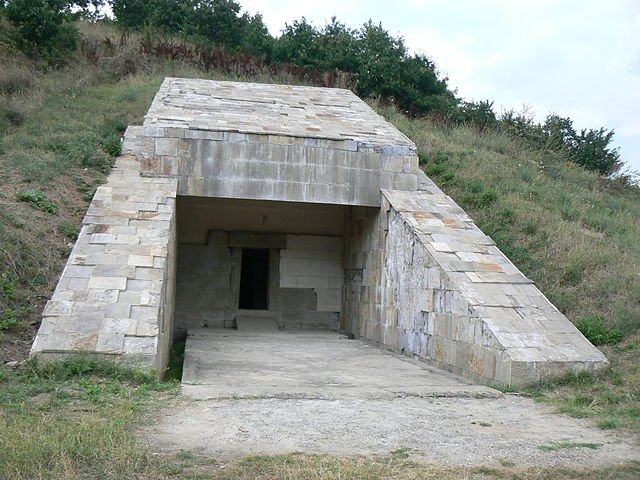
Zhaba Mound
Zhaba Mound 1 is a Thracian mound near Strelcha, Bulgaria, investigated by the EPOS expedition under the direction of Dr Georgi Kitov. This funerary complex dates from the 5th–4th centuries BC and is thought to contain the burial of a Thracian king of the Odrysian tribe. Its dimensions make it one of Bulgaria's largest mounds. Local people call it Zhaba Mound, or Frog Mound, because it lies near a marshy pool inhabited by frogs. Zhaba Mound rises more than 20 metres high and measures between 80 and 90 metres in diameter. Investigations established that a small building once stood on its summit, possibly a sanctuary. Various artefacts, such as fragments of ram figures, emphasise the site's possible secular role. Discoveries also include a berm around the mound's perimeter that served to drain and protect the earthwork. The tomb is a unique architectural structure with a façade combining various decorative elements, including bead strings, Ionic and Lesbian cymatia, geometricised ivy sprays and others. Particularly interesting is the discovery in the first chamber of a four-wheeled chariot and the skeletons of two horses harnessed to it, highlighting the site's important role in Thracian culture. The second chamber is a domed structure typical of Thracian tombs. Although robbed in remote antiquity, Zhaba Mound 1 has revealed numerous archaeological treasures, including red-figure vessels by ancient Greek makers, alabaster and glass objects, a gilded lion's head, figurines and amulets. All this makes it a key archaeological site for studying Thracian history and culture in the region.
Central Bulgaria, near Strelcha, 5th–4th centuries BC
Share:


