The Camels of Hisarya

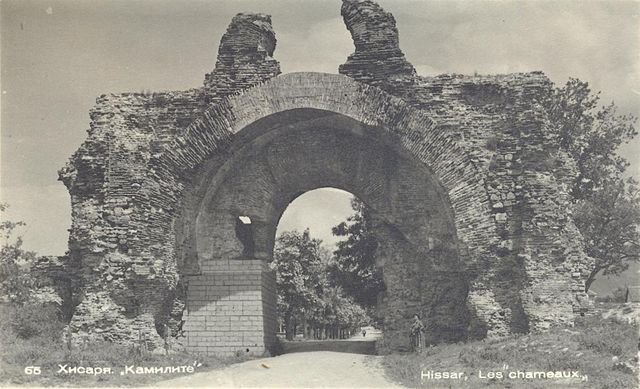
The Camels of Hisarya
The history of Hisar is closely connected with the Roman Empire. When the Romans arrived in these lands, they found a small Thracian settlement. However, the town's healing springs attracted the attention of the Roman rulers. In the 3rd century, the town was renovated and enclosed by a defensive wall; at that time it bore the name Augustae. A Latin inscription survives from this period, relating to the construction of baths in honour of the Roman emperors Maximilian Galerius and Licinius the Elder, towards the end of the 3rd and beginning of the 4th century.
At the end of the 3rd century, during the Gothic attacks, the town suffered destruction and fires. When rebuilt in the early 4th century, it received the name Diocletianopolis, associated with Emperor Diocletian. It became the third-largest town in the province of Thrace, after Philippopolis (Plovdiv) and Beroe (Stara Zagora). Diocletianopolis was laid out according to all Roman standards of town planning, with broad streets, statues of gods, marble baths and aristocratic residences. To protect it from enemy attacks, the town was surrounded by an imposing defensive wall, one of the best-preserved monuments of its kind not only in Bulgaria but also in the Balkan Peninsula. The wall was built by Thracian craftsmen and formed a quadrilateral, constructed in mixed masonry with four courses of brick. The wall, parapet and battlements stood 12 metres high; the surviving remains now reach 7 metres. The best-preserved sections are the western and southern main gates. The latter is called 'The Camels' because of its symbolic shape: two separated gateways resembling the backs of camels facing one another.
Hisarya, 1st–7th centuries
Share:


