Tatul Sanctuary

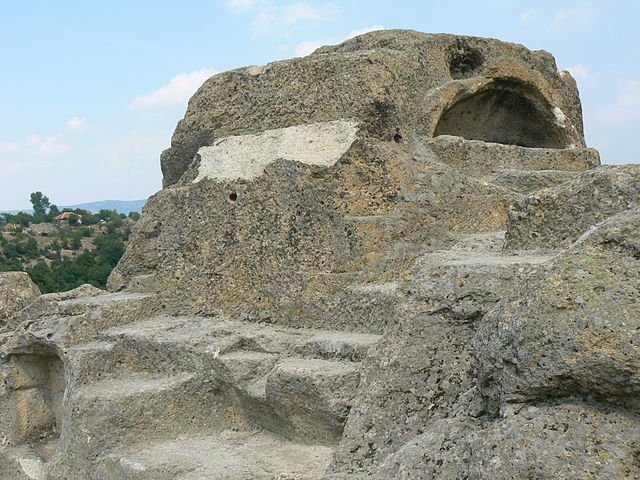
Tatul Sanctuary
Tatul is an age-old sanctuary of the ancient Thracians near Momchilgrad. This archaeological site includes a unique sarcophagus shaped like a truncated pyramid, making it one of the most remarkable megalithic monuments in Bulgaria and the world. The complex lies 200 m from the village of Tatul, in the Kara Dere and Kaya Basha localities, approximately 15 km from Momchilgrad. The sanctuary includes a rock mass whose summit forms a truncated pyramid. The complex contains two sarcophagi, a quadrangular bed for the principal altar, a three-metre well and numerous cuttings in the rock. Archaeological excavations date the complex to the late fifth and early fourth centuries BC. Professor Ivan Venedikov proposed that the site was a sanctuary dedicated to Orpheus. He suggested that the hill near Tatul served for a funerary ritual in which the Thracian priest Orpheus was buried beneath a monolithic rock. This explains the shape of the "pyramid-sarcophagus" and the various rock cuttings.
Large-scale archaeological excavations conducted in 2004–2009 under Nikolay Ovcharov clarified the site's chronology and showed that it had been inhabited and used for approximately 5,000 years, from the Late Chalcolithic to the Middle Ages.
This megalithic complex is an important element of Bulgaria's archaeological and historical heritage, providing information about ancient religious and cultural practices in the region.
Kardzhali Province, near Tatul, Fifth millennium BC–thirteenth century AD
Share:


