Megalith Natural Landmark

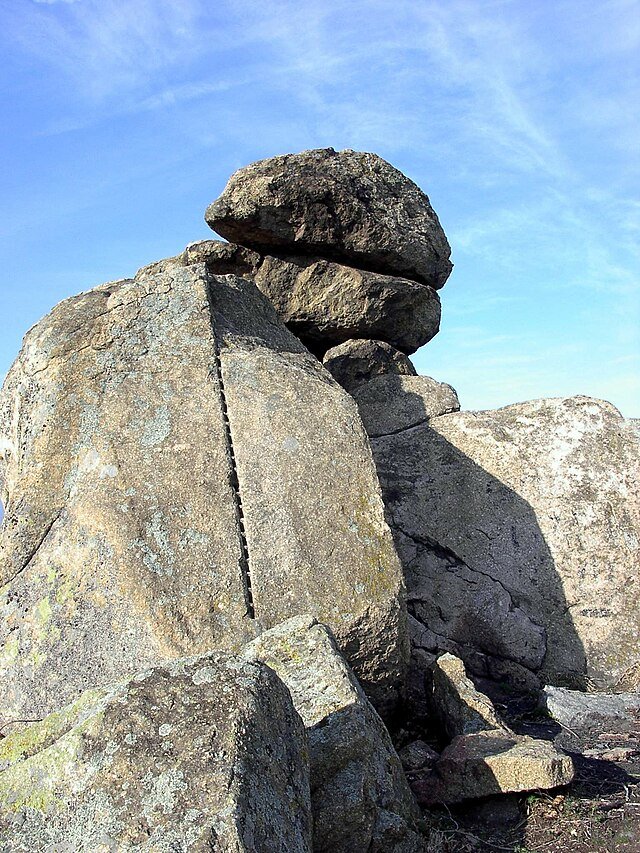
Megalith Natural Landmark
The megalith above the village of Buzovgrad is an ancient sanctuary dating from the Late Chalcolithic and the beginning of the Bronze Age. This historic site lies on the northern slopes of Sarnena Sredna Gora, near Buzovgrad in Kazanlak Municipality. In recognition of the megalith's historical and cultural value, the Roman fortress of Buzovo Kale has also been associated with it. Work is currently under way on the idea of declaring the megalith a monument of national significance and popularising it as 'Bulgaria's Stonehenge'. On 28 May 2013, the site was declared a natural landmark. The megalith consists of a group of rocks into which an opening about 1.80 metres high has been cut. The sun shines through this opening at sunset. The structure includes two horizontally placed stone blocks forming a trilithon, with their base forming part of the massif's bedrock. Various rock structures, including a 'throne' and a 'sacrificial altar', stand on the hill around the megalith. According to archaeologists, the megalith was used by the population preceding the Thracians, and its proposed construction date lies between 1800 and 1600 BC. In addition to its ritual purpose, it may have served as a military observation and communication centre, with bronze solar mirrors providing links to other installations. The megalith known as the Gate of the Mother Goddess probably symbolised a 'Gateway to the Beyond' in Thracian beliefs. It is thought to have been used for ritual ceremonies and the burials of Thracian aristocrats and priests. Its principal function was to maintain the Thracian calendar by measuring the length of the astronomical year and the seasons, thanks to the precisely constructed opening through which the setting sun's rays pass on the day of the summer solstice, 21 June.
Buzovgrad village, Kazanlak Municipality, No information
Share:


