Great Bolgar

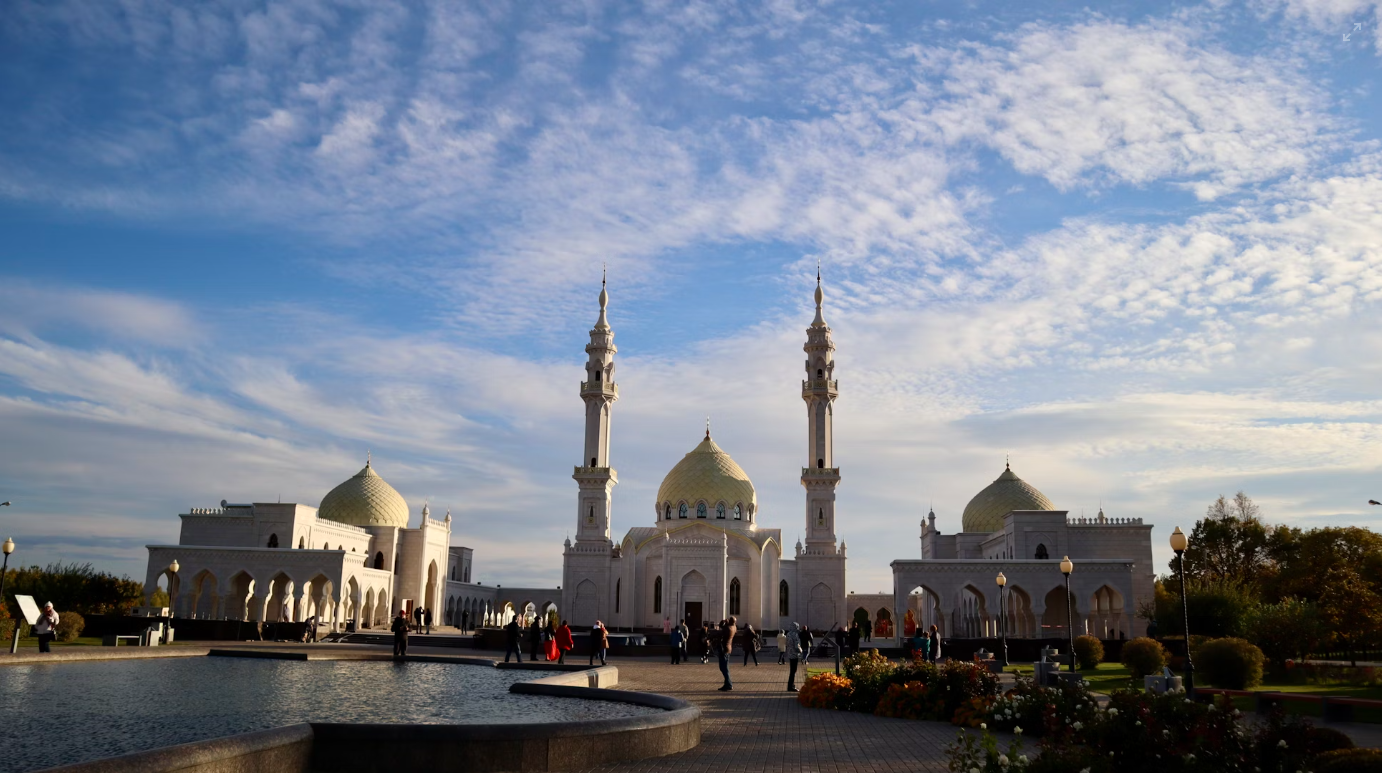
Great Bolgar
Great Bolgar was a medieval city in what is now the Republic of Tatarstan, Russia. It is included in a UNESCO World Heritage property. It stood on the left bank of the Volga, locally its southern bank, approximately 70 kilometres south of present-day Kazan. It was bordered by the settlement of Privolzhsky to the east and the village of Bolgar to the west, the latter now part of the town of the same name. It existed from the eighth to the fifteenth century and was the capital of Volga Bulgaria and the Golden Porte.
Great Bolgar was a major trading and spiritual centre that played a significant role in Eurasian history. Its position on the Volga made it an important junction on the northern Silk Road route connecting Europe, the Middle East and Central Asia. The city was known for gold production, weapons, pottery and coin minting.
Its archaeological remains include many medieval buildings, such as the Great Mosque, the minaret, several mausoleums (Northern, Eastern and Black) and the Khan's Palace, also known as the House with Towers. Many are now part of the Bolgar historical and architectural museum reserve. In 2014, the site was formally inscribed on UNESCO's World Heritage List. Some accounts state that only a small part of its territory has been excavated, making it valuable for future research.
The city has a rich cultural heritage and had an ethnically diverse population. Armenian and Christian cemeteries have been found, demonstrating the presence of different religious and ethnic communities. Research points to a mixture of Bulgar, Finno-Ugric and nomadic roots from which modern Tatars, Chuvash and Bashkirs descend.
After the Mongol conquest in 1236, Bolgar retained its importance as a spiritual and commercial centre of the Golden Horde. In the fourteenth and fifteenth centuries, invasions repeatedly devastated it, including Timur's in 1395 and that of Russian troops in 1431, after which it never regained its former glory.
In 1722, Peter I ordered the first measures to preserve the ruins, among Russia's earliest instances of state protection of cultural heritage. Orthodox monasteries were subsequently founded. During the Soviet period, Bolgar served as a spiritual alternative to the Hajj for the region's Muslims, a 'lesser Hajj'.
In the early twenty-first century, a major programme began to restore and promote Bolgar. The White Mosque, the Bread Museum, cultural centres and educational workshops were established, along with the world's largest printed Quran.
Share:


